Expeditions, war stories & culture

War stories, articles & game guides

Gamer

Tribute

2026

Expeditions,

War Stories &

Culture

Contents

Howling Fjord WotLK Classic Lore Guide: Quests & Easter Eggs | Vikstone's Chronicles

Howling Fjord’s hidden lore, Easter eggs, and pop-culture references, plus the storyline threads tying the vrykul and the awakening of Northrend back to Warcraft III and forward through Cataclysm, Legion, and into the modern game. Told through Vikstone’s War Journal and original 2008-2009 screenshots from the Viking frontier.

Howling Fjord Museum

Vikstone’s Chronicles · Northrend Lore Series


Howling Fjord was where Vikstone first glimpsed the enemy’s true scale.

The Nordic cliffs and fog-shrouded harbors introduced the vrykul, ancient half-giant warriors awakened from millennia of slumber to serve the Lich King.

At Valgarde, Vikstone walked the same shoreline where Arthas Menethil first landed in Northrend years earlier, the old foundations of that doomed expedition still visible beneath Alliance fortifications.

In Wyrmskull Village, he witnessed the Lich King claim King Ymiron’s spirit, a chilling demonstration of power over even the mightiest vrykul lords. And at Westguard Keep, a worgen infestation revealed Archmage Arugal’s return, a threat that would follow him into Grizzly Hills.


What follows is the Fjord as Vikstone found it in 2008, its buried secrets, the truth Blizzard hid about where the vrykul truly came from, and the war as he recorded it, quest by quest.

Vikstone Portrait Act 1
Illustrated by Christian DiBari and Simon Gough.
Howling Fjord quest ledger preview

Vikstone's Chronicles · Saga Runestones

Howling Fjord: Seven Echoes Beneath the Cliffs

Select a runestone to see what the Fjord reveals, what its landscape remembers, and where the story surfaces again.

Runestone I · Awakening

The Vrykul Return

The vrykul never vanished. They slept through ages of decline, then woke beneath the Fjord convinced the Lich King was a new god of death. At Gjalerbron, hibernation becomes recruitment as Scourge necromancers drag an ancient people into Arthas's modern war.

The buried truth

Their enchanted sleep was an attempt to outlast the Curse of Flesh. The world mistook it for extinction.

What Vikstone sees

Dormant warriors culled in the Waking Halls during Sleeping Giants, and Queen Angerboda's rites ending with the Lich King himself appearing.

The later echo

Utgarde Pinnacle, Ymiron's fall, and his soul surfacing again in Legion's Maw of Souls.

From the War JournalSleeping Giants → Dealing With Gjalerbron

Runestone II · Fortress

Utgarde's Dark Pact

Utgarde Keep dominates the Fjord's skyline. Prince Keleseth binds the Dragonflayers to the Scourge, their handlers turn proto-drakes into weapons, and Ingvar's resurrection introduces the val'kyr as living judges of who gets to fight beyond death.

The buried truth

Dragonflayer power rests on enslavement: of proto-drakes, of the dead, and finally of their own future.

What Vikstone sees

Sky-borne attacks on Valgarde, Keleseth's bargain, Ingvar's defeat, and Annhylde the Caller raising him moments later.

The later echo

Val'kyr become central to Icecrown, the Forsaken succession, and Sylvanas's bargains after Wrath.

From the War JournalIf Valgarde Falls… → The Clutches of Evil

Runestone III · Bloodline

Humanity's Burden

Spirit visions at Wyrmskull and Nifflevar hold the zone's most consequential secret. The small, flesh-afflicted infants Ymiron ordered killed were hidden away by defiant parents, and their descendants became humanity.

The buried truth

Humanity begins inside the vrykul story, as the children vrykul society condemned and a few parents refused to give up.

What Vikstone sees

Thoralius the Wise reconstructs Ymiron's decree and exposes cruelty, rather than destiny, as the turning point.

The later echo

Titan-forged ancestry, Tyr's legacy, Ulduar's revelations, and humanity's place in Azeroth's older design.

From the War JournalThe Echo of Ymiron → Anguish of Nifflevar

Runestone IV · War

Two Beachheads, Two Consciences

Each faction brings its own danger ashore. The Alliance answers the vrykul siege with scorched earth, burning Skorn under orders that include a quest literally named Gruesome, But Necessary. Across the water, Forsaken apothecaries at New Agamand refine a new plague and field-test it on living vrykul.

The buried truth

Northrend hands each faction room to turn its worst instincts into weapons, and both take the offer.

What Vikstone sees

Torched longhouses at Skorn on one coast, and plague trials like Field Test spraying Halgrind on the other.

The later echo

The Wrathgate catastrophe, the Battle for the Undercity, and the Blight's long afterlife.

From the War JournalBurn Skorn, Burn! → Gruesome, But Necessary

Runestone V · Sea

Shorefolk & the Kvaldir

Kamagua and Shield Hill preserve a quieter Northrend. The Kalu'ak trade, mourn, and travel by turtle routes older than either faction's campaign, while mist-wreathed kvaldir raid the coast.

The buried truth

The Fjord had roads, rites, and rivalries long before the Alliance and Horde declared it a battlefield.

What Vikstone sees

Graves robbed at Shield Hill, relics returned too late, sea-raiders rising in The Dead Rise!, and a people defending memory rather than empire.

The later echo

The Kalu'ak coastal network, Helya's maritime dead, and the vrykul sea-mythology Legion returns to.

From the War JournalThe Dead Rise! → A Return to Resting

Runestone VI · Titan Legacy

Old Stones, New Thunder

Around the Explorers' League digs at Steel Gate and Baelgun's Excavation, the Scourge war gives way to something much older. Iron rune constructs guard what the dwarves uncover, and the Ember Clutch shows proto-drakes bred and broken into weapons. The Fjord is an early warning that Northrend's deepest conflict predates Arthas.

The buried truth

The undead are only the newest occupants of a landscape shaped by titan keepers, their servants, and their betrayals.

What Vikstone sees

Dig sites overrun by rune-carved constructs, artifacts pulled from the earth, and primitive dragons turned into military assets.

The later echo

Thorim and Loken, the Storm Peaks, Ulduar, and the deeper history of proto-dragons.

From the War JournalLightning Infused Relics → The Delicate Sound of Thunder

Runestone VII · Memory

Where Arthas Came Ashore

Daggercap Bay is a battlefield of canon as well as history. Warcraft III places Arthas's landing here, while WotLK's Forgotten Shore moves his abandoned camp to Dragonblight, and later sources redraw the map again. The prince's landing became a legend with competing archaeological layers.

The buried truth

Valgarde's old foundations and wrecks preserve the earliest version even when later sources move the site.

What Vikstone sees

The harbor Arthas once used, echoes of Muradin's expedition, and a shoreline already haunted before the new war begins.

The later echo

The Forgotten Shore's ghosts, the burned fleet, and Falric and Marwyn waiting in the Halls of Reflection.

From the War JournalDaggercap Divin'

Vikstone, night elf warrior of US-TerokkarVikstone's field read: history does not stay buried in the Fjord. It wakes, gets weaponized, and returns using a new name.

Where Arthas Landed: The Fjord’s Buried History


Where did Arthas actually land in Northrend? The answer has changed across Warcraft III, the novels, Chronicle, and Exploring Azeroth, creating one of the franchise’s most documented “repeating retcons.”

In Wyrmskull Village, a hidden encounter lets the Lich King kill you personally. His opening line, “I was once a shaman,” is a rare nod to Ner’zhul’s presence within the merged entity, and sparked years of community debate about which mind truly controls the Frozen Throne.

New Agamand showcases the Forsaken’s darkest work: plague development with no pretense of defense. The vrykul stronghold of Utgarde Keep looms over the zone as both dungeon and origin story for humanity itself.

And at Kamagua, the tuskarr offer a rare glimpse of Northrend life untouched by war.


Arthas’s Landing Site: Valgarde, Daggercap Bay… or the Forgotten Shore? (The Retcon Trail)

Arthas’s Landing Site: Valgarde, Daggercap Bay… or the Forgotten Shore?


Where did Arthas actually land in Northrend? The answer has changed so many times.

The original answer was simple. In Warcraft III’s “The Shores of Northrend” (2002), the loading screen puts Arthas at Daggercap Bay. He reunites with Muradin, establishes camp, and the story moves on. Christie Golden’s novel preserved this seven years later: “Northrend was the name of the land, Daggercap Bay the site where the Lordaeron fleet made harbor.”

Then WotLK complicated it. The Forgotten Shore quest chain in Dragonblight visually and narratively claims a different bay as Arthas’s encampment. Ship wrecks litter the mist-shrouded coast, ghostly soldiers of the 1st Legion wander the sands, and the quest The Forgotten Tale lets you commune with them via murkweed elixir. The ghosts don’t know Arthas betrayed them. They still believe he’s a hero.

They were the 1st Legion, the Lordaeron expeditionary force that followed their prince across the sea, and their ghosts still hold the beach they died on.

It’s the quest giver Orik Trueheart, himself a 1st Legion survivor, who tearfully reveals the truth: “They think Arthas to be some great hero, when in truth it was Arthas who ordered the ships to be burned. It was Arthas who left us all for dead in this frozen wasteland!”

Chronicle Volume 3 (2018) tried to tidy things up by sliding the landing back to the Howling Fjord, a retcon of the retcon. Then Exploring Azeroth: Northrend (2022) swung the pendulum again, with Muradin’s own journal placing Arthas at the Forgotten Shore. Though since these are Muradin’s in-character recollections, they could be in-universe mistakes rather than canonical retcons.


The Forgotten Tale

The Forgotten Tale


Squaring the Circle

Some lore scholars have tried to reconcile the two: Arthas landed at Daggercap Bay (Howling Fjord), then established his main base camp at what became the Forgotten Shore (Dragonblight) after capturing a Scourge position. The ships, moved to the main camp’s bay, were burned there. This interpretation allows both locations to be “correct” in different senses.

Supporting this: Baelgun’s Excavation Site sits in the Howling Fjord; Baelgun Flamebeard was Muradin’s second-in-command. And Westguard Keep’s location might have been designed as Muradin’s original base before the narrative shifted.


Where to See Both Versions

Daggercap Bay/Valgarde (Howling Fjord): Start at Valgarde, described as “the oldest Alliance settlement in Northrend.” Older sourcebooks explain why everyone keeps landing here: Daggercap is the finest natural harbor in Northrend, high rock walls, calm water, and the only real anchorage for large ships on this coast. If you are bringing a fleet, you land at Daggercap. That geography is half the reason the retcon debate exists at all.

Early Alliance quests send you diving beneath the docks in Daggercap Divin’, where Harold Lagras, a somewhat shifty character clearly more interested in looting than official salvage, has you recover supply crates from shipwrecks in the bay. These wrecks nod to prior landings.

The town’s founding is itself contested: originally described as built by Arthas’s survivors who “forced the Drakkari and furbolgs back into the Grizzly Hills,” WotLK implies it was established by the later Valiance Expedition. Exploring Azeroth: Northrend swings back to the original version.

Forgotten Shore (Dragonblight): On Dragonblight’s southeastern coast, the shore sits under mist that never lifts, the bay jammed with rotting hulls, the beach strewn with wreckage. The Forgotten Shore quest chain, starting with Orik Trueheart and the Forgotten Shore, has you commune with the spectral soldiers still trapped there.

The ghost dialogue is heartbreaking: one Forgotten Knight says, “We worked our fingers to the bone trying to get through the woods to the shore only to find that we were too late. Our only way home had been destroyed.”

In Warcraft III, when the emissary arrived with the king’s recall order, Captain Luc Valonforth ordered the men to cut through the forest to reach the ships. The ghost is remembering the mission. The dead on this beach are still living inside a 2002 campaign map.

A dwarf rifleman sighs and says, “I wanna get back home to Ironforge. I surely do miss my wife and children.”

The chain does not leave them there. Orik ends it by placing a crystal from his old friend Zelig at the center of the shore, an orb he had clutched for years whenever grief over this beach overtook him, so the spirits can finally see the truth through his heart and be freed.


Historical Parallel:

The “burn the ships” moment echoes Hernán Cortés, who actually scuttled his fleet at Veracruz (the “burning” is a myth that started with a 1558 painting) to prevent retreat during the conquest of the Aztecs; and before him, Tariq ibn Ziyad, who allegedly did the same when invading Hispania in 711 CE. Arthas joins a long tradition of commanders who transformed their men’s fear into fury by eliminating escape.


The Mercenary Question:

Adding another layer of inconsistency: who actually burned the ships?

The sources can’t agree on that either. In Warcraft III, Arthas hires ice trolls, ogres, and goblin sappers to do the work. Then he tied off the loose end: he blamed the hired hands for the burning, a half-truth since they had done it at his command, and let his enraged soldiers cut them down.

The Death Knight manga depicts the mercenaries as humans. The Halls of Reflection dungeon splits the difference with “Shadowy Mercenary” ghosts who appear human. Warcraft III: Reforged (2020) kept the non-human mercenaries but gave the previously unnamed ship captain a name: Captain Marwyn, who later appears as a boss in Halls of Reflection, creating a direct through-line from the landing to the endgame. Falric, his fellow Halls of Reflection boss, was already a named captain in the original 2002 campaign; Reforged extended the same courtesy to Marwyn.

The Halls of Reflection ghosts close the loop from the other side too: the spectral soldiers you fight there are members of the 1st Legion, the same force still standing on the Forgotten Shore.

The Lich King’s Hidden Monologue


During The Echo of Ymiron, a draenei shaman named Thoralius the Wise sends you into the spirit world to uncover the vrykul’s secrets. Light the incense burner and you’ll phase into a realm that’s fallen under the Lich King’s sway, with val’kyr patrolling Wyrmskull Village.

Drift too close to his apparition and a secret mini-encounter fires: Magnetic Pull → Grasp of the Lich King → a full monologue → Wrath of the Lich King (instant death). It’s optional, easy to miss, and unforgettable.

The spell’s tooltip says: “Extinguishes the life of one who has exercised poor judgment.”


What He Says

First encounter:

  1. “Shamanism has brought you here… Its scent permeates the air. (laughs) I was once a shaman.”
  2. A Val’kyr Soulclaimer offers: “Shall we prepare it for you, my lord?” The Lich King refuses: “No, minion. This one is not ready.”
  3. “Do you feel it, mortal? Death seeps through me, enveloping all that I touch. With just a snap of my finger your soul will languish in damnation for all eternity.”
  4. “But… It is not yet your time to serve the Lich King. Yes, a greater destiny awaits you. Power… You must become more powerful before you are to serve me.”
  5. “Now watch, val’kyr.” (Then he kills you, demonstrating his power to his minion.)
  6. Second encounter (and subsequent attempts): “Persistence or stupidity? It matters not. Let this be a lesson learned, mortal!” (Then kills you again.)


Anguish of Nifflevar

The Anguish of Nifflevar


The Ner’zhul Revelation

That shaman line sparked years of community debate. Ner’zhul was the chieftain and elder shaman of the Shadowmoon clan on Draenor before Kil’jaeden transformed him into the first Lich King.

Arthas was never a shaman. When players heard this dialogue, many argued that it proved Ner’zhul still existed within the merged entity, contradicting the novel Arthas: Rise of the Lich King, which suggested that Arthas had destroyed Ner’zhul’s persona entirely.

Community Manager Crygil later clarified on the official forums: “He didn’t actually erase the persona of Ner’zhul. In point of fact, these two beings merged to make up what was collectively known as ‘The Lich King.'” The debate over who truly controlled the Lich King’s actions persisted until Shadowlands finally showed Ner’zhul’s remnant in the Sanctum of Domination.

Ner’zhul’s manipulation by Kil’jaeden (who posed as his dead wife Rulkan) led him to turn the orcs against the draenei. Now a draenei shaman’s quest brings you face-to-face with what Ner’zhul became.


Wrath’s Endgame Foreshadowed

This encounter is an early preview of the expansion’s central revelation.

Years later, at the Frozen Throne, after killing your entire raid, the Lich King says the quiet part out loud: “No questions remain unanswered. No doubts linger. You ARE Azeroth’s greatest champions. You overcame every challenge I laid before you… You trained them well, Fordring. You delivered the greatest fighting force this world has ever known… right into my hands—exactly as I intended!”

The Howling Fjord monologue plants the seed. “It is not yet your time to serve… You must become more powerful.” He’s not taunting. He’s coaching. Every dungeon, every raid boss, every near-death experience was preparation for this moment. The Lich King needed champions strong enough to lead his undead armies. What he didn’t account for was Tirion Fordring and the Light.


How to Trigger (or avoid) it:

  • Trigger the scene: Use the Incense Burner, then walk toward his patrol path while in the spirit phase. Val’kyr circle nearby.
  • Avoid it: Stay tight to the longhouse at (~60.3, 51.5) to complete the quest safely.
  • Recovery tip: He will one-shot you regardless of level or gear. Just corpse-run back, re-use the burner, and continue. Worth experiencing at least once.


Deep-cut Lore:

This is the rare moment in Wrath where the Lich King does not just appear before you, he personally executes you, mid-leveling, in an outdoor quest. He manifests again in the Fjord during The Slumbering King, where you interrupt Queen Angerboda’s ritual to awaken her husband Ymiron.

The Lich King teleports away with the still-dormant king, promising: “Not yet, Ymiron. I have other plans for you. You will serve me better within Utgarde Pinnacle. And if these insects survive to find you again, you will get the chance to avenge your wife.”

He’s already planning encounters for you.


The Echo of Ymiron

The Echo of Ymiron


King Ymiron Tie-in:

  • King Ymiron ruled the vrykul in the deep past, before the Sundering, back when his people still wore skins of titan-forged iron. Under his reign, the Dragonflayer clan defeated their ancient enemies the jalgar, but victory was followed by the Curse of Flesh transforming his metal people to vulnerable flesh.
  • Origins & the Curse of Flesh: When vrykul women began birthing small, “malformed” children, Ymiron blamed the absent titans and concluded they had cursed his people. He outlawed titan worship entirely and decreed that all afflicted children must be killed, or their parents executed at Gjalerbron. Some families refused and fled with their children. They smuggled the infants to Tirisfal Glades, where legend held that other vrykul had fled with the keeper Tyr long ago. Those “aberrations” eventually became humanity. The quest Anguish of Nifflevar lets you witness Ymiron’s speech firsthand: “The gods have abandoned us! Where are the titans in our time of greatest need?… For it is the titans that have cursed us!” Thoralius’s conclusion: “There is no extinct ‘missing link’ to humans as the Explorers’ League proposed. The vrykul are the missing link. They are the progenitors of humanity.”
  • Sleep & servitude: Ymiron ordered his people into enchanted sleep beneath Northrend in places like Gjalerbron, hoping hibernation would stave off the curse of flesh. When the Lich King stirred from the Frozen Throne, many vrykul awakened, believing him to be a god of death, including Ymiron, who served willingly. He wore a locket around his neck as a memento of his lost queen.
  • After Wrath: Slain in Utgarde Pinnacle, Ymiron found the Halls of Valor closed to him. When the Battlelord first proposed raising him, Odyn refused outright: “King Ymiron betrayed his people and doomed them to a cursed existence.” The warrior’s paradise stayed closed to him for exactly that reason. Instead, Helya claimed him for purgatory on the shores of the Maw of Souls. In Legion, the Warrior class campaign takes you there to defeat Ymiron, the Fallen King again. The twist: the Battlelord convinces Odyn that forcing Ymiron into eternal service would be “a perfectly suited punishment” for his betrayal. Odyn laughed and agreed. Ymiron now stands in Skyhold’s Arena of Glory, serving the keeper he once rejected, forever. Talk to him in Skyhold and he makes his feelings plain: “I will spit on your grave!” and “I would die a thousand deaths to see you suffer!” Fifteen thousand years old and still the angriest man in the room.


Trivia Bits:

  • Ymiron’s name references Ymir, the primordial frost giant whose corpse Odin used to create the world in Norse mythology. Fitting for a king whose people were created by the Titans.
  • Queen Angerboda is named for Angrboða, the giantess who bore Loki’s monstrous children: Fenrir, the Midgard Serpent, and Hel.
  • Ymiron has been compared to an “evil King Arthur”, a sleeping king who returns to defend his people, but twisted toward darkness.
  • The Memento of Angerboda, a trinket he drops in Legion’s Maw of Souls, suggests the relationship was genuinely loving despite their cruelty: even in Helya’s purgatory, the fallen king carries a keepsake of his wife, matching the locket he wore in life.

Forsaken Plague Development (New Agamand)


On the cliffs of New Agamand (≈ 53.6, 66.4), Chief Plaguebringer Harris of the Royal Apothecary Society walks you through weaponizing a vrykul-specific strain of Forsaken blight. The mini-arc: New Agamand → A Tailor-Made Formula → Apply Heat and Stir → Field Test, is the Horde’s starkest moral-gray moment in the Fjord and a prelude to Wrath’s blight storyline.

I wrote about Azeroth’s engineered outbreaks through a physician’s eyes in Plagues of Azeroth, and New Agamand is where that story gets its Horde origin chapter.

In-game, the terrain around New Agamand is visibly dead and brown amid the Fjord landscape.


New Agamand


How the quest “lab” works:

  1. A Tailor-Made Formula: Kill Thorvald (Dragonflayer patriarch) and collect Patriarch’s Blood; he fled the already-sprayed Halgrind.
  2. Apply Heat and Stir: At the Cauldron of Vrykul Blood (≈ 54, 67), combine the blood with Harris’s samples to brew a Balanced Concoction.
  3. Field Test: Take a Plague Spray to Halgrind and test on Plagued Dragonflayer Vrykul. Results are “inconclusive.” Harris blames “perhaps the low temperatures of this climate.”
  4. Tip: Tag first so the mob is Plagued before it dies; that’s what the quest checks.


Why it matters (the long arc):

  • The New Plague/Forsaken Blight is engineered to kill living and undead. Forsaken wear masks because it harms them, too. Later lab demos in the Apothecarium show a human woman bleeding from every orifice and a Forsaken criminal’s skin breaking open to weep black ichor, both dying to the same strain.
  • Foreshadows Wrathgate: Putress hijacks the blight and shells Scourge, Horde, and Alliance alike. After Undercity is retaken, Kor’kron oversight clamps down on R.A.S. work.
  • Echoes for years: Battle for Lordaeron (BfA) deploys a refined formula; Harris himself resurfaces to develop a bio-weapon against Gilneas from Shadowfang Keep. In 9.2.5’s “Return to Lordaeron,” you help begin cleansing lingering contamination using Maldraxxus plague eaters.


Absholutely... Thish Will Work!

Absholutely… Thish Will Work!


Where Else the Blight Shows Up (and prequel threads):

  • From these prototypes straight to Dragonblight: quests like The Forsaken Blight add a reactive agent potent enough to turn Scourge into “piles of goo,” fired via blight-spreader catapults near Naxxramas. The Scarlet Onslaught is mysteriously immune in Blighted Last Rites, a loose end never fully explained.
  • Alliance intel trail: SI:7 once seized Berard’s Journal from Master Apothecary Faranell, giving Spymaster Mathias Shaw hope of countermeasures against “the inevitable next incarnation.”
  • Complicit hands: The warlock Felgrim helped gather early materials for the Blight, later considering himself unforgivable once Putress’s intent became clear.
  • A stolen sample lets Peppy Wrongnozzle “perfect” a batch by accident; her vrykul test subject liquefies in the Alliance quest Absholutely… Thish Will Work!, a dark mirror of Harris’s inconclusive Fjord trials.


Cleanup, Limits & Open Questions:

  • Radiation-like footprint: heavily blighted zones (e.g., Southshore) require a “cooling-down period” before habitation; players even scan danger levels with a meter that reads like a Geiger counter UI.
  • Can it truly be cleansed? Evidence is mixed. Large swathes of Gilneas remain blighted for years; the region only becomes habitable again by patch 10.2.5. Cenarion/Argent efforts can heal Scourge blight, but efficacy against Forsaken blight is uncertain.
  • Powerful counters have limits: Alexstrasza and the red flight halted the spread at Wrathgate, but arrived too late to save most victims (and the plague of undeath lay beyond her clean removal). Jaina’s massive Ring of Frost at Lordaeron dispersed/contained clouds but may not permanently purge them. Kaldorei nature magic contained blight in Darkshore, yet full regional cleansing remains unclear.


Harris himself is still weaponizing it a decade later. His own words at New Agamand tell you everything: “We Plaguebringers tend to be slightly more practical than the average apothecary. After all, we deal with the logistics of deploying the plague.”

Utgarde Keep: The Vrykul Stronghold


Carved into the cliffs above Daggercap Bay, Utgarde Keep looms over Wyrmskull Village, your first full tour of vrykul architecture in Wrath. The 5-man entrance sits around (58.1, 49.9), with its level-80 sister wing, Utgarde Pinnacle, perched above.

Utgarde was the expansion’s debut playable dungeon at BlizzCon 2007 (and Leipzig Games Convention), the only Wrath instance attendees could actually run that year.


What you’ll notice inside:

The Dragonflayer clan has turned Utgarde into a war-foundry: ringing forges, weapon racks, kennels, and corrals where vrykul train proto-drakes as raid mounts.

The keep has a hierarchy; the higher you live, the higher you rank, and the cliff face is carved with giant skulls and flying buttresses. Water thunders down both sides of the façade; the structure is built into the fjord the zone is named for.


The finale: After you kill Ingvar the Plunderer, the val’kyr Annhylde the Caller descends and resurrects him for phase two.

Her judgment is merciless on both difficulties: “Ingvar! Your pathetic failure will serve as a warning to all… you are damned! Arise and carry out the master’s will!” Early in development she had a second, gentler line, “You have been judged and found worthy! Arise and slaughter in the Lich King’s name!”, but Blizzard cut it before launch. The cut line hints at the Ymirjar and Vargul split, the two fates awaiting vrykul the Lich King judges: exaltation for the worthy, a lesser undeath for the failures. Ingvar got the failure verdict.

This same Annhylde later sacrifices herself to resurrect Sylvanas after the Banshee Queen’s suicide at Icecrown Citadel, a thread that wouldn’t pay off until Cataclysm’s Edge of Night.


Utgarde Keep


Quest spine:


All the banners and carvings mark the Dragonflayers, sworn to King Ymiron, whose story culminates upstairs in Utgarde Pinnacle. Their pact with the Scourge brought Prince Keleseth to reside here as the Lich King’s eyes and ears in the Fjord, while Ingvar serves as the clan’s chosen warlord, hammering Valgarde from the air.

Before you face Keleseth inside, Horde players see him taunt High Executor Anselm at Vengeance Landing. He arrives with vrykul bodyguards, invites the Forsaken to rejoin the Scourge, then teleports behind his escorts so Anselm’s archers kill them instead of him. Classic blood prince move.

Utgarde compresses Wrath’s vrykul culture into one walkable exhibit: fortress culture, proto-drake shock troops, and val’kyr-mediated undeath. It bridges the Valgarde beachhead to the deeper vrykul arc that ends with Ymiron, your first contact with the Death God’s new allies.


Fast run tips:

  1. Disarmament: Grab weapons off walls and racks as you move. Don’t backtrack.
  2. Ingvar Phase 2: Save big defensives/interrupts for his undead form; the rez triggers immediately.
  3. Trash skips: Hug edges around furnace floors to dodge extra packs without LOSing your healer.


Extra details & trivia:

  • Two wings, one fortress: Utgarde Keep (5-man ~70–72, also Heroic 80) and Utgarde Pinnacle (5-man 80, Heroic). There are also the Utgarde Catacombs below, a separate non-instanced area with mini-bosses and the Ring of Judgment quest hub.
  • Secret works: A tunnel to Gjalerbron is being dug by mindless undead. Vrykul consider manual labor beneath them.
  • Mythic wink: “Utgarde” nods to Útgarðr of Norse myth, the realm of giants, fitting a race of half-giants.
  • Ingvar the legend: His brute strength is legendary even among vrykul; rumor has it he once bested King Ymiron in a brawl. The truth is unknown, but purveyors of that tale usually don’t live for a retelling.
  • Skarvald & Dalronn: The second boss pair embodies a vrykul tradition, forcing unlikely partners to work together. Some say it’s to let divergent abilities complement each other; others say it’s for Ymiron’s amusement.
  • Keleseth returns: After you kill him here, he’s raised again alongside Princes Valanar and Taldaram to form the Blood Prince Council in Icecrown Citadel, your rematch at Wrath’s endgame. During Shadowlands’ Scourge resurgence, Ingvar was reanimated yet again by Mawsworn kyrian in Ymirheim, and the Argent Crusade sent adventurers to kill him a third time. Annhylde, having spent herself resurrecting Sylvanas, was herself raised by Helya in the Maw to fight players in the Sanctum of Domination’s The Nine encounter. The val’kyr who made a career of resurrecting the fallen ended up on both sides of the transaction.
  • BlizzCon banana loot: At BlizzCon 2007, Blizzard hadn’t finalized Keleseth’s loot table yet. His placeholder drops? Bananas that summoned chimp pets.

Kamagua: The Tuskarr Haven


Kamagua is the Kalu’ak’s calm, sea-worn port on the Isle of Spears, led by Elder Atuik. Round-backed, bone-and-wood longhouses that resemble monstrous fish from the outside (with lower levels dug into the permafrost for warmth) ring a working harbor at (25.9, 57.9).

It’s the largest tuskarr village in the Howling Fjord and a major stop for roaming clans making their seasonal circuits. The village also serves as a refuge: after Northsea pirate slavers destroyed nearby Iskaal and slaughtered their captives, survivors fled here, and Elder Atuik’s trilogy of Feeding the Survivors, Arming Kamagua, and Avenge Iskaal shows Kamagua sheltering, arming, and finally avenging its displaced kin. For the last one, Atuik hands you the Horn of Kamagua, which summons a Kalu’ak warrior to fight at your side. The fisherfolk do not go to war often, but they do not send you alone either.

From here, the great turtle Green Island ferries passengers to Moa’ki Harbor in Dragonblight (and from there, Walker of Waves continues to Unu’pe in Borean Tundra). The turtle carries a roomy wooden deck and cargo hold on its shell, crewed by two tuskarr, one of whom spends the voyage making sure the turtle doesn’t eat the carrots dangling from the steering pole. 

Blizzard’s developers noted: “The method of transportation we settled on is a giant turtle with a deck mounted on top of its shell, very much like the turtles from Warcraft II. It’s simple, effective, grounded in Warcraft lore, but it’s also one of those light moments that are so important to create the iconic Warcraft feel.”


The story you play: Your arc starts up on the cliffs at the Ancient Lift with Orfus of Kamagua, then drops you into the Kvaldir mystery via The Dead Rise! and the hand-off Elder Atuik and Kamagua. You shuttle evidence back to Atuik, then push into follow-ups that frame the Kvaldir (tuk-hariq, “walkers of the fog”) as a mist-borne threat. The tuskarr believe the mists themselves enable these spectral raiders to manifest, viewing them as angered spirits of slain vrykul.

Kamagua’s questline establishes this conflict early, foreshadowing how Kvaldir pressure resurfaces along every Northrend coast from Borean Tundra to Hrothgar’s Landing.


Daily “palate cleanser”: From Anuniaq at (24.6, 58.8), pick up the daily The Way to His Heart… Net Tasty Reef Fish and lure a Reef Bull across to a Reef Cow for a matchmaking vignette (and Kalu’ak rep).

The Northsea Pirates slaughtered the alpha bull, Big Roy, to make soap for their decks, and you are the one who killed him during Swabbin’ Soap while infiltrating Scalawag Point.

Anuniaq doesn’t know. In fact, the matchmaking daily only unlocks after you’ve completed Swabbin’ Soap: the game requires you to kill Big Roy before it lets you play cupid for the herd you orphaned. His completion text hints at absolution: “Whatever you might have done in the past, know that you have helped with Kamagua’s future!”


Kamagua


Traveler’s notes:

  1. Ride to the Ancient Lift (~40, 60) to descend into Kamagua.
  2. Use the turtle-boat Green Island to hop Kamagua ⇄ Moa’ki Harbor (and from there on to Unu’pe in Borean Tundra).
  3. Photo ops: the carved bone posts along the docks; kites fluttering over the harbor; contrast with the iron-and-runestone austerity up at Wyrmskull/Utgarde.


Tuskarr Cultural Reference (Kamagua)

  • Architecture & warmth: Longhouses resemble monstrous fish from the outside; interiors are sunk into the earth to retain heat. Lamps burn whale oil; tools and art are made from whalebone, sealskin, and volcanic glass. Heavy sealskin furs cover floors and doorways; colorful weavings hang on the walls, dyed with squid ink and fish scales.
  • Nomads of the Cold Sea: Clans roam by season, guided by stone elders, massive cyclopean ancestor heads that mark fishing routes and serve as spirit-houses. Shamans conduct rites to seat an elder’s spirit in its statue, allowing the living to commune with their wisdom. When clans migrate, mothers and children travel across the ice in sleds drawn by draft seals, while the heartier fishers sail alongside, catching food en route.
  • Who they pray to: Northrend tuskarr honor Tayutka (protection, ensuring survivors have food and shelter), Issliruk (war, depicted as a silver eagle who grants courage), Oacha’noa (wisdom, the Goddess of the Depths), and Karkut (“He Who Watches Over the Dead,” ensuring fallen tuskarr don’t lose their way). On the Dragon Isles, the Iskaara worship Gral, while the Kauriq tribe honors three Great Spirits: Kraunot (Mountain Wind), Otu’rorq (Tumultuous River), and Niliuq (Ocean), regional echoes of a sea-centered worldview.
  • Silap Inua:  Silap Inua (“the breath/spirit in all things”) underpins tuskarr practice, similar to shamanism but distinctly their own. Mystic Tomkin explains: “It is harnessed by all thinking peoples to heal or harm. It is the power of life. It is the power of souls living and dead.” The Blue Dragonflight’s Nexus War, attempting to control all magic, was considered the greatest threat to tuskarr and all life itself.
  • Boats, kites, and… carrots: Travel runs on giant turtle ferries steered by carrots on poles. Children fly kites for play. The sky over tuskarr harbors is filled with brightly colored kites even during troubled times.
  • Daily life: Fishing and whaling determine status; every clan has a catch master who weighs each fisher’s haul and records them using multicolored cords on a “counting staff.” Food shares are equal, but catches above the basic requirement earn knots on the fisher’s cord. Knots trade within the clan for luxuries and tools. (Fine embroidery also earns knots, though it’s less respected than fishing.)
  • Biology tidbits: Built for cold, tuskarr can survive ice-water immersion that would kill most Azerothians in minutes. Both males and females sport mustaches; their sighs come out as long, whistled notes through pursed lips. Families breed penguins as farm animals.
  • Every tuskarr NPC in Kamagua is male. Female tuskarr weren’t seen in-game until Dragonflight, though voice lines existed in WotLK’s files. Female tuskarr first appeared in lore via “One Small Tuskarr.”


Story breadcrumbs: Kamagua opens the prologue of Christie Golden’s Arthas: Rise of the Lich King. The wind roars in from the ocean, tearing at hides stretched over sea-creature bones. Elder Atuik waits in silence while young tuskarr shiver (“not with cold, not the tuskarr, but with fear”), sensing the supernatural storms emanating from the Frozen Throne. The village also closes Garth Nix’s short story “One Small Tuskarr” (from Folk & Fairy Tales of Azeroth), where young Taruka sails a sea monster’s corpse into Kamagua harbor, earning the name “Taruka Beastkiller” and asking the catch master how many knots her catch is worth.

Post-Shadowlands, the Bronzebeard brothers visited Kamagua and noticed fishing boats heading east. When Brann asked where they were going, the tuskarr said they’d learned of far-off lands with welcoming ports, ones their ancestors had traveled to long ago.

The Dragon Isles called; the ancient routes were reopening.

The Ancient Lift: Scenic Descent (and a Nordic echo)


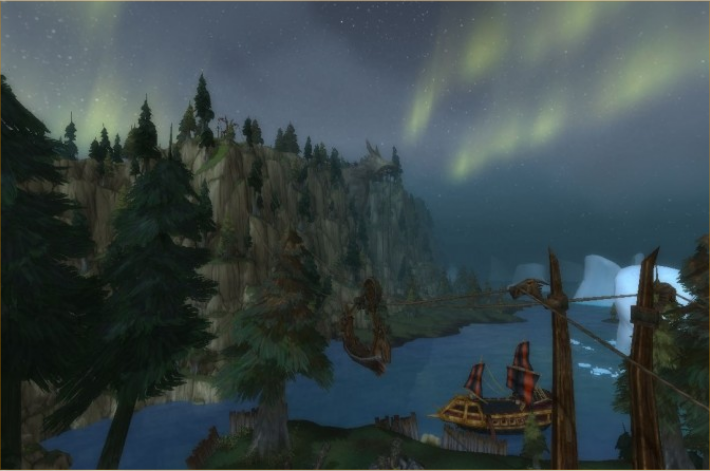
A cliff-to-sea gondola linking the mainland wall to the Isle of Spears and Kamagua. The top station stands beside Orfus of Kamagua at approximately (40, 60); board a wooden car shaped like a vrykul dragon-boat and ride down to Kamagua’s harbor on the island’s northwestern shore.

Geographically, the lift sits south of Ember Clutch and north of New Agamand on the fjord’s southwestern rim.

The Bronzebeards’ survey in Exploring Azeroth: Northrend lingers on it too: dragon-boat cars swaying on their rope in the wind off the water, vrykul machinery that the tuskarr long ago claimed for themselves, riding it up to the cliffs when the hunting calls.

In beta the subzone was called “Gondolwrench,” a name that sounds like a goblin engineering firm, before Blizzard renamed it to fit the zone’s Nordic theme. The old name has since vanished from the modern wikis; it survives only in archived 2009 pages, a small fossil of the era this site is built to preserve.


Kamagua


Part of a Vertical Network

The Ancient Lift is actually one of six vrykul-built lifts dotting Howling Fjord: the Excavation Lift, Midwall Lift, Stonewall Lift, Vengeance Lift, and Westwind Lift complete the set.

The lifts are part of vrykul civilization: a cliff-dwelling culture that treated verticality as a fact of life and engineered accordingly. Their cliff-dwelling culture required infrastructure to move between sea level and the heights where they built their longhouses and keeps. The Vengeance Lift near Vengeance Landing features a massive stone dragon head carved into the cliff face, with chain-operated wooden platforms hanging from the dragon’s mouth.

The Ancient Lift’s enclosed gondola design makes it safer than its chain-based cousins; you ride inside the car rather than timing a jump onto a moving platform.


Why It Matters

The Fury of the Kvaldir quest chain begins at Westguard Keep, where a tuskarr named Lunk-tusk reports that he and his partner Orfus were investigating strange happenings near Shield Hill when they were attacked by the undead.

Lunk-tusk escaped; Orfus was last seen near the Ancient Lift. Finding Orfus leads to the chain’s central mystery: pirates from the Northsea Freebooters have been plundering a vrykul burial ground, disturbing ancient spirits called kvaldir. The quest Elder Atuik and Kamagua specifically instructs players: “To get to Kamagua you must take the Ancient Lift, behind me. Take the lift directly to Kamagua and find Elder Atuik.” 

The ride paints the zone’s cultural contrast: vrykul iron and stone engineering up top, tuskarr bone-and-wood villages below. Two peoples sharing one steep geography in very different ways; the vrykul built the infrastructure, but the tuskarr adopted it for hunting trips to the mainland cliffs.


Kamagua Ancient Lift


Real-World Echo

If you’ve ridden Norway’s Loen Skylift, the Ancient Lift will feel familiar. Loen’s cable car lifts passengers from fjord level to 1,011 meters (3,316 feet) atop Mt. Hoven in just five minutes, one of the steepest aerial tramways in the world, with gradients up to 60 degrees. The gondola car hangs 170 meters above ground at its highest point. Both rides transform near-vertical terrain into a practical commute.

Blizzard’s art team cited Scandinavian fjord landscapes as primary references for the zone, and the lift makes that influence rideable.


Stormheim’s Spiritual Successor

Legion’s Stormheim zone continued the vrykul vertical aesthetic with a different solution: grappling hooks. Players receive a harpoon early in the zone and can fire it at rings scattered across cliffs and mountains, zipping to heights no other method would reach.

Stormheim and Howling Fjord share the largest vrykul populations on Azeroth, and both zones treat verticality as a defining gameplay element rather than an obstacle.

Pirates, Proto-Drakes, and Sleeping Giants


Scalawag Point is Howling Fjord’s pirate hideout, a refuge for outcasts running from both factions. Dive beneath the nearby docks and you’ll find shipwrecks worth exploring: a sunken exhibit of the zone’s nautical history that most players swim right past.

The Ember Clutch proto-drake hatchery connects to one of Wrath’s most beloved mount grinds. These aren’t the sleek drakes of Wyrmrest; they’re the primitive ancestors, and the questline here foreshadows the Storm Peaks revelation about where drakes actually come from.

Utgarde Pinnacle hides a Terminator reference in its loot table.

The vrykul awakening is one of Northrend’s core lore threads. These giants didn’t die out; they slept through the Curse of Flesh while their “deformed” children fled south and became humanity.

And Kamagua’s turtle ferries aren’t just transport. They’re one of the few pieces of tuskarr engineering players actually use, connecting the Fjord’s coastal settlements through routes that predate both Alliance and Horde arrival.


Scalawag Point: Pirate Refuge

Scalawag Point: Pirate Refuge


A cutaway pirate cove carved into Garvan’s Reef, the southernmost islet of the fjord, run by the Northsea Freebooters at around (35.5, 81.5). Picture Booty Bay’s nastier, scrubbier cousin: three frigates at anchor, trap-laced piers, and a market that runs on fibs and stolen goods. 

The Freebooters broke off from the Southsea Freebooters at some point, and the two factions despise each other. What the Northsea crew lacks in numbers, they compensate for by being worse criminals and murderers than their southern counterparts.


Scalawag Point


How you get in:

From Kamagua, Grezzix Spindlesnap sends you on Street “Cred” to meet “Silvermoon” Harry. While that quest sits in your log, the Freebooters treat you as “one of us,” a neat scripted fake-alliance. Abandon it and they draw steel again. Harry warns you up front about the artifacts they stole: everyone who touched them ended up dead, missing, or both.

He’s not exaggerating.


Micro-stories to hunt:

  1. The ghost ship loop. The Lost Shield of the Aesirites → Mutiny on the Mercy → Sorlof’s Booty puts you aboard the cursed Sister Mercy, a ghost ship whose crew was killed about a month before you arrive, most likely by the giant Sorlof, who now holds their stolen loot. You nab blasting powder from mutinous gunners, man “the big gun” on the poop deck, and one-shot the giant for his booty. Captain Ellis’s skeleton crew actually makes puns about running a “skeleton crew.”
  2. The coup in the cave. A Traitor Among Us → Zeh’gehn Sez → A Carver and a Croaker → “Crowleg” Dan → Meet Number Two → The Jig Is Up ends with assassinating “Mad” Jonah Sterling and returning his spyglass. Sterling’s name likely nods to Long John Silver from Treasure Island (sterling silver, plus “Jonah” as nautical bad luck). The Frozen Heart of Isuldof, one of the cursed vrykul artifacts, drove him so paranoid that he abandoned the port for a cave with his pet bear Hozzer. When you drop him to half health, he shouts “Ye’ll never get me spyglass, bilgesuckers!” and leaps into the bear pit for protection. Hozzer rewards years of loyal service by eating him alive. After Sterling’s death, Annie Bonn takes over and vows to rein in the raids. Her name references Anne Bonny, an Irish pirate who terrorized the Caribbean in the early 1700s, one of history’s few documented female pirates.
  3. Witch-doctor comedy. The traitor questline begins when Annie suspects a mole. You’re directed to Zeh’gehn, an “authentic witch doctor” whose family hails “all the way from Zul… something or other.” His patois is nearly impenetrable: “Ye gotta bring me a croaker, matey. Aft I an’ I show ye who da blaggard be, mon.” You return to Handsome Terry for translation, and it turns out Zeh’gehn wants a frog and a knife for scrying magic. His divination exposes “Crowleg” Dan as a Southsea Freebooter mole. Confronted with the verdict (“Umm… the frog says you’re a traitor, ‘matey'”), Dan folds instantly: “Curse that frog! Yes, I joined the Southsea crew – you want to make something of it, mate?” Handsome Terry’s eulogy sets the tone for pirate grief: “Dan was me old friend… AND he owed me money. Either way, if he was working with the Southsea mongrels he got what he deserved.”
  4. A fun easter egg:  Deselect Dan without attacking him, and he mutters, “For the Alliance.” It contradicts everything the questline reveals about him, which is exactly why it’s charming: it’s almost certainly a default human voice bark the developers never swapped out.


The deeper lore:

Before the war against the Lich King, Sterling led his crew to Shield Hill, a vrykul burial ground, and robbed the graves of ancient warriors. This desecration brought the kvaldir to Northrend’s shores, the angry spirits of the dead howling for vengeance. The stolen artifacts scattered across the zone and cursed everyone who touched them.

Sterling got the Frozen Heart and went mad. Abdul the Insane held the Staff of Storm’s Fury on a ship at Iskaal, equally unhinged. The Shield of the Aesirites ended up with Sorlof after the Sister Mercy’s crew died trying to reclaim it.

The Ancient Armor of the Kvaldir never even reached Scalawag, its transport attacked by Forsaken en route. Returning these artifacts to Shield Hill was the tuskarr’s plan to appease the spirits, but it came too late to prevent the kvaldir invasion.

Scalawag is where the Kalu’ak storyline pivots from grief to recovery. The pirates stole tuskarr grave-goods, and returning cultural artifacts pays Kalu’ak reputation. But there’s darker history here too: Sterling ordered raids on tuskarr villages and tried to sell captives as slaves.

None survived. 


At the time, the pirates believed tuskarr couldn’t survive more than three days outside their cold climate. Later expansions proved that wrong (tuskarr turn up thriving in Pandaria and on the Dragon Isles), but it didn’t matter here. The brutality of captivity killed Sterling’s prisoners long before climate ever could. Sterling deserved what Hozzer gave him.

The Freebooters also carried so many rats that the local bears went rabid from disease.


The Staff of Storm's Fury

The Staff of Storm’s Fury


Modern echoes:

After the war against the Jailer, Muradin Bronzebeard visited Scalawag Point while writing Exploring Azeroth: Northrend and described it as a “wretched port of riffraff and rascality,” still paling in comparison to Booty Bay. Annie Bonn still runs the operation decades later, though Muradin notes the crew has gone from “monstrous to merely annoying.”

The Freebooters even showed up in the War Crimes novel, recruited by Zaela to attack the Temple of the White Tiger. A tauren pirate fought King Varian Wrynn and lost. Zaela abandoned them, and the pandaren rounded up the survivors. Not their finest hour.

Battle for Azeroth players will recognize the pirate haven archetype in Freehold, Kul Tiras’s lawless port where “the only rule is that there are no rules.”

The Irontide Raiders are spiritual successors to the Northsea Freebooters, right down to the regime change questline.

Photo ops: Frame the three frigates from the pier traps at the entrance. Grab a second shot inside Sterling’s cave mid-coup, right before Hozzer’s betrayal. The Sister Mercy sailing past makes for nice scenery if you time the ghost ship’s dock cycle.

Shipwrecks SE of the Docks: Scalawag’s Sunken Exhibit


Slip off Scalawag and swim to two nearby wrecks around (37.8, 84.6) and (36.9, 85.7). They’re the sites for Forgotten Treasure, a pirate art heist in reverse.

After earning passage with Street “Cred”, broker Handsome Terry sends you diving and hands you a Fish Bladder for underwater breathing.

He explains his niche: “I’ve made my fortune by specializing in treasure that regular pirates don’t appreciate: art, antiquities, collector’s pieces.”

Terry calls the hulks the remnants of Black Conrad‘s fleet, stripped of coin but still hiding museum-worthy relics. The pirates combed these wrecks for gold and jewelry “years ago,” but two ancient artifacts remained untouched because regular buccaneers couldn’t recognize their value.

His idle dialogue confirms it: “I don’t know much about art… but I know what I like!”

Terry’s operation has a reputation. Eavesdrop on the Drunken Northsea Pirate stumbling around Scalawag and you might catch: “I ‘eard Terry fenced one of ’em pictures for a thousand gold. Maybe I can get in some of that artwork dealin’ too!”


Scalawag Point


Precise pickups:

  1. Eagle Figurine: (37.8, 84.6), in the eastern wreck (the hull with the intact mast). The parallels to The Maltese Falcon are hard to ignore: a priceless bird statuette, a criminal underworld, and someone willing to dive into dangerous waters to claim it. Bogart’s Sam Spade would feel at home here.
  2. Amani Vase: (36.9, 85.7), in the western wreck. Terry specifically calls it “museum-quality”. The Amani are the forest trolls whose empire once spanned all of northern Lordaeron from their capital of Zul’Aman. This ceramic predates human kingdoms by millennia. How it ended up in a pirate captain’s hold is anyone’s guess, but whoever sold it probably had no idea what they were pawning off.


The debris field around the wrecks tells the quieter fjord story. Rum crates, snapped spars, barnacled cargo, the scattered leavings of vessels that never made port. Down here the story is ordinary loss: Freebooters combed the dead for trinkets and left the rest to the barnacles. The seabed around Garvan’s Reef is a graveyard that keeps giving.


Black Conrad’s backstory: The fleet’s captain didn’t die at sea. Through a separate quest chain, Taruk the tauren pit-fighter (who runs gambling operations at Scalawag) reveals that Black Conrad, a notorious gambling addict who died owing money, mostly to Taruk.


In Dead Man’s Debt, Taruk unfolds a map with an X on it and adds the detail that makes it a Scalawag story: “He hid his treasure on tuskarr land.” You track Conrad’s buried treasure to the Isle of Spears.

Disturb the site and he rises with two Spectral Sailors, snarling “Yarrrr! If it’s me treasure yer lookin’ for… yer gonna have to fight for it!” before dying (again) with a resigned “Yarrrrr… dead again!”

His treasure pays his debts posthumously, and Taruk lets you keep the surplus, signing off with a job offer: “If you’re ever in need of something more permanent, I’m sure I could arrange for something.” A pit-fighter, a bookie, and apparently a fixer.

Conrad’s ships ran aground, but his debts survived him. Scalawag’s economy really does run on plundered culture as much as gold.


Kalu’ak connection: The tuskarr connection runs deeper than treasure; see the Scalawag Point entry above for the full Kalu’ak arc.

Bonus encounter nearby: The orca “Scoodles” patrols the same waters for another Scalawag quest. “Silvermoon” Harry explains that “Mad” Jonah Sterling, in his paranoid madness, stole Harry’s prized Sin’dorei Scrying Crystal and fed it to the orca.

Harry insists he didn’t name the animal, calls it an “overinflated goldfish,” and pleads with you to “rip out my beautiful sin’dorei crystal from its stomach.”

When you return the crystal, Harry cradles it and coos: “Oh my precious! Did the big, mean whale hurt you? It’ll be ok. I’ll never let you out of my sight again!” (pure Gollum, and surely deliberate)

Scoodles circles around (~38, 84), making it efficient to kill the orca before or after looting the relics if you’re running the whole pirate circuit.

Proto-Drake Hatchery: Ember Clutch


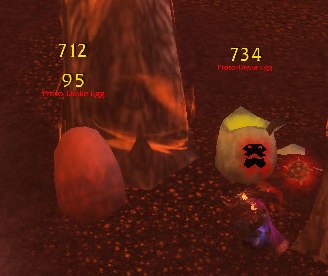
The Ember Clutch is a scorched nesting ground in west-central Howling Fjord at (41-43, 52-55) where proto-dragons once laid eggs in peace before the vrykul woke and moved in.

Stand at the edge and you notice it before any quest explains it: the fire holds its border like a fence line, and the pines burn without ever burning up. That’s the first clue: this isn’t natural flame.

Ancient magic keeps these woods burning eternally, creating the ideal incubation temperature for proto-drake eggs. The Ember Clutch Ancients who roam the scorched pines will tell you as much.


Ember Clutch


What you do here:

Alliance: The Clutches of Evil from Captain Adams at Westguard has you destroy 15 Proto-Drake Eggs and kill 15 Proto-Whelp.

Adams frames it as a tactical necessity: “Since we arrived here, the Ember Clutch has been ablaze; there must be some sort of perverse magic at work. And lately it seems to be growing. My men tell me that if we don’t do something quickly, we’ll be surrounded on all sides by the fire within a few weeks’ time!”

The Ancient will later clarify who’s actually responsible for the spreading flames.


Both factions: Approach any Ember Clutch Ancient for Root Causes.

The Ancient corrects your assumptions immediately: “All things in nature seek a balance. It is only through the interference of those not in tune with that harmony that the balance is shifted. You waste your efforts when you kill the whelps and drakes. The real culprits behind the expansion of these magically burning woods are the newly awakened vrykul and their master, Skeld Drakeson.”

You’re sent to hunt 5 Dragonflayer Handlers and their boss, Skeld Drakeson, at the south end of the clutch (~42, 53). The quest completion is tinged with pessimism: “Perhaps now the proto-drakes and their whelps can go back to living peacefully. Somehow I doubt it with the reawakening of the vrykul.”


The Lore Framework: Dragons Before Dragons

Ember Clutch is your first hands-on primer for proto-dragons: primal dragons untouched by the titans. The distinction matters. Long before the five Aspects were blessed, proto-dragons arose from elementals who avoided imprisonment in the Elemental Plane and instead remained on Azeroth, where some gradually transformed into creatures of flesh and blood.

Brann Bronzebeard uncovered evidence that proto-dragons may have origins in elemental drakes like stone and storm drakes, though the inhabitants of Deepholm, Skywall, the Firelands, and the Abyssal Maw aren’t exactly chatty on the subject.

These proto-dragons lived in what they called the “Dragonwilds” of northern Kalimdor. Among them, Galakrond grew monstrous through cannibalism, his body sprouting hideous mutations as he absorbed the life essence of other proto-dragons, his vomited-up victims returning as undead called “the not-living.” 

The titan-keeper Tyr rallied five proto-dragons (Alexstrasza, Malygos, Neltharion, Nozdormu, and Ysera) to defeat Galakrond. The novel Dawn of the Aspects by Richard A. Knaak tells this story through Kalecgos, who relives Malygos’s memories. Afterward, in recognition of their courage, the titan-keepers channeled their masters’ power to bless those five, transforming them into the Dragon Aspects, the first true dragons.

The Aspects spread a rumor that they were created from Galakrond, the “Father of Dragons,” to prevent other proto-dragons from following Galakrond’s cannibalistic path. Some proto-dragons rejected the titans’ “ordering” entirely. These rebels drank deep from elemental powers and were reborn as the Primal Incarnates: Raszageth the Storm-Eater, Iridikron the Stonescaled, Vyranoth the Frozenheart, and Fyrakk the Blazing.

They demanded Tyr be exiled from the dragons’ new home. When the Aspects refused, it sparked a cataclysmic conflict known as the War of the Scaleborn about 20,000 years ago. The dragons ultimately won and imprisoned the Incarnates, but the schism never fully healed.


Seeing vrykul breed, break, and ride proto-drakes here foreshadows this deeper draconic history, which you’ll continue to explore in Dragonblight (Galakrond’s skeleton), Storm Peaks (titan-keeper drama), Ulduar (Razorscale), and much later in the Dragonflight expansion, where the Primal Incarnates return.


Two Wrongs

Two Wrongs…


The Dragonflayer Angle: Weapons of War

The Dragonflayer clan doesn’t just use proto-drakes as transportation; they’re central to Dragonflayer military identity. Twenty thousand years ago, after the curse of flesh stripped them of their iron skin, the Dragonflayers began enslaving proto-dragons to balance their newfound vulnerability.

Unlike the Winterskorn clan, who viewed proto-dragons as mere beasts of war, the Dragonflayers used them as mounts and hunting companions. In time, the creatures became inseparable from their culture.

Skeld Drakeson’s operation at Ember Clutch is a breeding program. The Handlers scattered around the clutch with their lassos and spikes reinforce the “capture and break” motif; you can see the chains and pens near the vrykul encampment at the south end.

Blizzard’s original Wrath preview describes the scene from the docks: “Enraged vrykul charge the town’s defenders, overwhelming them with their sheer size and savagery. Buildings catch fire and burn before your eyes, and the cries of battle mingle with the shrieks of the proto-dragons flying low overhead.”


Bridge to the Future: Storm Peaks and Ulduar

Storm Peaks and Veranus: Later, you’ll gather small proto-drake eggs to lure Veranus, the broodmother of the proto-dragons in the Storm Peaks and the riding drake of titan-keeper Thorim. The questline involves reuniting Thorim with his mount so he can bring war to his treacherous brother Loken. But it’s a trap. Loken captures both Thorim and Veranus and takes them to Ulduar. 

There, Ignis the Furnace Master fuses iron plates onto Veranus’s scales, transforming her into the plated monstrosity Razorscale, an optional boss encounter in the raid. 

Utgarde Keep and War Foundry: Inside Utgarde Keep, the Dragonflayer halls double down on proto-drakes as shock mounts. You’ll fight enslaved Proto-drakes (painful rend, fire breath, knockbacks) and Proto-Drake Handlers (Debilitating Strike, Unholy Rage buff).

The dungeon journal describes “the vicious Dragonflayer clan builds massive weapons of war in ever-burning forges” and notes “proto-dragons at their command.” Concept art shows dragon pens built into the keep’s architecture. This is where the raw material from Ember Clutch gets trained and deployed.


Valkyrion and the Plagued Proto-Drakes: Even darker than Dragonflayer bondage is what the Hyldnir frost vrykul do at Valkyrion in Storm Peaks. After their leader Yulda the Stormspeaker sold the village to the Lich King in exchange for becoming a Val’kyr, the Hyldnir began capturing proto-drakes and their eggs to dunk them in the Blighted Pool, waters filled with corruption and disease intended to infect them with the plague. The resulting plagued proto-drakes became undead mounts for Scourge vrykul in Icecrown. Gretta the Arbiter later sends you to destroy the plagued eggs. 


Field Notes

Egg mechanics: Smashed Proto-Drake Eggs can spawn Proto-Whelps. Those walking around the area will occasionally use the Birthing Flames ability to incubate one of the scattered eggs, causing a hatchling to emerge.

Chain carefully if you’re undergeared. Whelps use Flame Breath (fire damage in a cone), and adult Proto-Drakes add Flames of Birth (AoE pillar of flame) and Wing Buffet (knockback cone). Position yourself near walls when possible to avoid getting punted into additional packs.

Handler kit: The Dragonflayer Handlers wandering near the pens have lassos, spikes, and chains scattered around their posts. The handlers themselves are straightforward melee mobs, but Skeld Drakeson inside the building at the south end can catch you off-guard if you pull carelessly.

The Ancient’s gossip: Before giving Root Causes, the Ember Clutch Ancient reveals that “these woods have burned for years beyond counting. They are fueled by an ancient magic and are the mating grounds for the brood mother and her proto-drake consorts.”

Which broodmother? It is speculated to be Broodmother Slivina in Sholazar Basin’s Savage Thicket, Veranus in Storm Peaks, or something entirely different. The game never clarifies.

Sholazar Connection: Speaking of Slivina, Muradin Bronzebeard theorizes that the Savage Thicket in Sholazar Basin, a theory Muradin himself admits he can’t prove.

The Savage Thicket is similar to Ember Clutch: a stretch of jungle caught in the same impossible burn: bounded, eternal, and never consuming its fuel. Proto-dragons nest there too, and vrykul travel from their villages to capture wild proto-drakes or gather fresh breeding stock. 

Did the ancient magic that sustains both fires originate from the proto-dragons themselves? From elemental ancestors? The game leaves it open.


Extra Lore Nuggets

Proto-dragon physiology: Proto-dragons do have tiny front arms tucked beside their wings. They’re described as “ruthless predators that cannot be reasoned with” by Scalecommander Azurathel in Dragonflight. Proto-dragon whelps grow at an incredible rate and can devour nearly twice their weight in raw meat per day. Some can unconsciously tap latent elemental energies to breathe fire or frost; others developed incredible fortitude or massive size.

It took decades for a proto-drake to mature fully. Most humanoid creatures in Azeroth would never live to see one grow from hatchling to fully mature drake.

Devilsaur connection: Proto-dragons resemble the devilsaurs and pterrordax of Un’Goro Crater, suggesting that dragons themselves could have evolved from dinosaurs.

Model history: In an early beta of Wrath of the Lich King, proto-dragons used placeholder models that looked like pale white drakes. That model was later repurposed for the Reins of the Albino Drake mount, awarded for the Leading the Cavalry achievement. So the Albino Drake is technically a beta proto-dragon.

Intelligence retcon: Earlier Wrath-era sources portrayed proto-drakes as bestial with limited sapience. Dawn of the Aspects changed this, showing that many proto-dragons, including the future Aspects, were fully sapient before the titans elevated them.

Dragonflight doubled down: the Primal Incarnates are articulate, strategic leaders who rejected the titans’ gift philosophically, not because they couldn’t understand it. The Ember Clutch Ancient’s mention of a “brood mother and her consorts” lands differently with that in mind. It might be (or might have been) a proto-dragon community with social structure and relationships.


Modern WoW Callback: Dragonriding

In Dragonflight, one of the first Dragonriding mounts players unlock is the Renewed Proto-Drake, obtained through the introductory campaign in the Waking Shores.

Unlike traditional mounts, drakes can be fully customized at Rostrums of Transformation with over 50 options: skin color, scale type, horns, tail, throat, body armor, snout, crest, jaw, brow, and more. Defeating Raszageth (one of those Primal Incarnates who rejected the titans) in the Vault of the Incarnates raid on any difficulty can drop the “Embodiment of the Storm-Eater” appearance, reskinning your proto-drake to look like the boss herself.

What the Dragonflayers tried to enslave, you ride as an equal partner across the Dragon Isles. The eggs you destroyed at Ember Clutch in 2008 have spiritual successors soaring above Valdrakken in 2022.


The Terminator’s Severed Arm (Utgarde Pinnacle)


In the very first room of Utgarde Pinnacle, the treasure-strewn entry hall labeled The King’s Hoard, scan the left-hand treasure piles as you enter. You’ll spot a severed mechanical forearm and hand modeled after a T-800 endoskeleton, located among coins, bones, and trophies.

Blizzard has slipped “Terminator hand” props into Azeroth multiple times. There’s one in a waterfront hut in Ratchet, a mechanical arm upright in an elongated jar on an end table, directly referencing the franchise’s most famous prop: the arm and microchip Cyberdyne salvaged from the first Terminator’s wreckage, the discovery that quietly sets up all of Terminator 2. 

There’s a more refined version in Ironforge’s Mystic Ward, first house on the left heading toward the Great Forge, top floor, which looks closer to the movie prop.


In Lower Blackrock Spire, there’s a skeletal hand lying near a river of lava, referencing T2’s famous “thumbs up as he sinks into molten steel” finale.

But Utgarde Pinnacle’s is the placement that actually means something. The arm sits in King Ymiron’s cursed collection, a grim relic preserved among the wealth of a vrykul monarch who sold his soul to the Lich King. It directly echoes Terminator 2: Judgment Day’s plot MacGuffin: the robotic arm and CPU recovered from the first T-800, which Cyberdyne scientists studied to develop Skynet. 

In the film, Miles Dyson’s team displayed these artifacts in a secure lab; the Connors had to break into Cyberdyne to destroy them before the technology could doom humanity. Here, Ymiron has hoarded the arm like any other trophy of conquest.


The King’s Hoard is cursed. Brigg Smallshanks watched his crewmates dive into those gold piles and rise again as the skeletons still rattling around the hall. Then the game hands you Junk in My Trunk, Brigg’s quest to loot silver bars, baubles, goblets, and a jade statue from the very hoard that killed them. A Terminator endoskeleton arm fits right in: one more artifact that doomed everyone who studied it, waiting for the next set of hands.


Other Terminator references in WoW:

Beyond the prop arms, Blizzard scattered Terminator nods throughout the game. Ossirian the Unscarred in the Ruins of Ahn’Qiraj yells “You are terminated!” when he kills a player, the franchise’s signature kill line (Sarah Connor delivers the original version in 1984; Arnold returns it word for word in Terminator 3).

The Hunter talent Bestial Wrath description originally read “the beast does not feel pity or remorse or fear,” directly lifted from Kyle Reese’s famous warning: “That terminator is out there. It can’t be bargained with. It can’t be reasoned with. It doesn’t feel pity, or remorse, or fear. And it absolutely will not stop, ever, until you are dead.”

The Warlock’s Felguard sometimes says “I’ll be back” when dismissed, Schwarzenegger’s signature line.


Where to find the King’s Hoard:

Enter Utgarde Pinnacle (the upper/northern portal on the keep). As soon as you zone in, you’re in The King’s Hoard. Take three steps forward, turn left, and sweep the treasure mounds. The arm is easy to miss if you sprint through the instance, because most groups immediately pull the first pack and never look at the scenery.

The subzone name “The King’s Hoard” appears on your minimap, the game’s label for the entire entry hall. The arm is just one of many cursed curios Ymiron has hoarded. Slow down and browse; the room is a mini-gallery of vrykul plunder.


Screenshot tips:

  1. Toggle UI off (Alt+Z), crouch the camera to loot-pile height, and frame the arm with the gold drifts behind it for a clean “artifact in situ” shot.
  2. Grab a second shot after defeating Ymiron to bookend the exhibit with the hoard’s “provenance” (you can exit through the gate to The King’s Hoard once he’s dead).

Vrykul Revival: Giants Who Slept the Curse of Flesh


In Gjalerbron and Nifflevar, Howling Fjord stages one of Warcraft’s foundational reveals: the vrykul, originally titan-forged iron beings created at Ulduar’s Forge of Wills, were warped by the Curse of Flesh. Their “runt” children were smuggled to distant shores and became humans.

Many vrykul chose magical hibernation to outlast the curse… until the Lich King woke them and claimed their loyalty as a “death god.”


The Slumbering King

The Slumbering King


Where to see it in-game:

  1. Gjalerbron (north cliffs): An active awakening complex. The Waking Halls are full of sleeping vrykul and necrolords trying to rouse them; the lower entry sits around (34.5, 13.1). Quests like Sleeping Giants hand you Awakening Rods and let you cull Dormant Vrykul: the “Great Sleep,” made playable. (The name derives from Norse Gjallarbrú, the bridge between living and dead; Captain Adams confirms the “Gj” is pronounced “Sh,” so “Shalerbron.”)
  2. Nifflevar (above Daggercap Bay): During Anguish of Nifflevar, incense visions show Ymiron’s culling decree (see the Lich King’s Hidden Monologue entry for the full Echo of Ymiron experience). “All malformed infants born of vrykul mother and father are to be destroyed upon birth! Our blood must remain pure always!” Here, the focus is on what the decree reveals about human origins.


The Lich King’s hand: When you kill Queen Angerboda at Gjalerbron’s Winter’s Terrace, the Lich King himself appears to stay Ymiron’s rise: “Not yet, Ymiron. I have other plans for you. You will serve me better within Utgarde Pinnacle.” Their awakening is his project.

And in Utgarde Pinnacle itself, you face Skadi the Ruthless, whose loyalty to Ymiron runs all the way back to the old kingdom.

This thread reframes human origins (vrykul descendants) and turns the Fjord into an origin gallery: curse → hibernation → Lich King revival. Later zones spin off into vrykul traditions (Stormheim’s Odyn/Valarjar, Kul Tiras’s Drust), but Howling Fjord is where you first see the cull order, the rescue of the “runts,” and the mass-awakening machine.


The Halls of the Ancestors in Icecrown holds a parallel dormitory, suggesting the Great Sleep was continent-wide. Its most famous sleeper is Iskalder, rumored to be the greatest vrykul hero who ever lived; an Icecrown questline has the Bone Witch send you to wake him and enslave his will for her plot against the Lich King. Even the awakening machinery gets stolen and repurposed by everyone with an agenda.


The Echo of Ymiron

The Echo of Ymiron


The Curse of Flesh (quick primer)

It’s a condition that affects titan creations… beings o’ great magic an’ malice sabotaged these creations by turnin’ their bodies tae flesh. (Felyae, dwarven scholar, in Pearl of Pandaria)

  • Source & spread. The Old God Yogg-Saron corrupted Ulduar’s Forge of Wills, seeding a curse that slowly turned titan-forged of metal/stone into mortal flesh, and even back-propagated to earlier generations. Keeper Loken raised armies from the Forge before realizing they were afflicted.
  • Timeline touchstones. About 15,000 years ago, the vrykul’s metallic hides weakened; “runt” births followed. Some parents hid these children on distant shores. Those lineages became humans. (Note: the Winterskorn clan’s hibernation was imposed by Dragon Aspects Ysera and Nozdormu during the Winterskorn War, a mist that locked them in tomb-cities. Ymiron’s Dragonflayer clan later chose voluntary hibernation.)
  • Unintended outcomes. The curse birthed mortal traits: resolve, courage, and heroism.
  • Who else did it hit?
    1. Earthen → dwarves (some Earthen hibernated; stone troggs → troggs).
    2. Mechagnomes → gnomes (later “reversal” attempts by Gearmaster Mechazod and King Mechagon fail or get stopped).
    3. Tol’vir and mogu also succumbed; both pursued partial reversions (e.g., Neferset pact, Lei Shen’s rites).
    4. One vrykul branch, the kvaldir, was further twisted through spirit-realm corruption. Their priestesses sought help and found only a malevolent entity.


Howling Fjord lets you see the story: titan-born giants turned flesh, hibernating through cosmic sabotage until a new death god flips the switch.

From Turtle Boats to Northern Paths: Kamagua’s Ferries


The Kamagua entry covers the ferry routes, crew, and carrot-steering mechanics. This entry traces the giant turtle as a design thread across Warcraft’s history, from Second War submarines to Dragonflight’s Iskaara coast.

Mythic resonance (the world-turtle thread): “World turtles” show up across myth; Ao in Chinese lore, Akūpāra/Kurma in Hindu cosmology, and fantasy’s Great A’Tuin. 


Moa'ki Harbor


Lineage & echoes (giant turtles across Azeroth):

  • Second War, southern seas. Stormreaver orcs (with Steamwheedle goblins) fielded giant turtle submarines, living hulls “pacified by potent spells of control” and fitted with watertight canopies and short-range steam canisters. A ruined sub corpse still lies on Crestfall, visitable today through Battle for Azeroth’s Island Expeditions: a Second War fossil on a modern battleground.
  • Naga & kaldorei coasts. Naga used turtle-back carriages “both in battle and in transportation of their supplies on to land,” as naturalist Gwennyth Bly’Leggonde explains in Classic Darkshore’s Beached Sea Turtle quests. Giant turtles once frolicked around Nordrassil before the Third War; some fled corrupt Teldrassil and beached themselves on the coast. The beached turtle quests have a detail worth surfacing: the cargo strapped to the dead turtles bore naga markings, which is how the naturalists deduced the carriage system at all.
  • Wrath onward (the Kalu’ak era). Northrend formalized turtle boats as public transit, your Kamagua route with Green Island and Walker of Waves, plus the moored craft The Half Shell at Moa’ki. The name is a Teenage Mutant Ninja Turtles nod (“heroes in a half shell”).
  • World-scale cousins. The pandaren’s Shen-zin Su (the Wandering Isle) is a fully sentient living island who carries villages, forests, and mountain ranges on his shell. Liu Lang befriended him 800 years before the Dark Portal. Among demigods: Tortolla, Ancient Guardian of land-and-sea creatures, fought in the War of the Ancients and later appears in Cataclysm’s Hyjal. Raid encounters include Tortos (Throne of Thunder); loa include Torga (Nazmir, BfA).
  • Legion quietly resurrected the WC2 gimmick: in Suramar’s vrykul village of Jandvik, a quest puts you on the back of a diving turtle, submerging and surfacing to bomb targets in the bay, the closest WoW has ever come to letting you pilot a giant turtle submarine yourself.
  • Dragonflight reprise. On the Dragon Isles, the Iskaara tuskarr still lean on turtle boats; Old Belfyr runs local routes while Young Belvo travels to far-flung coasts (Grizzly Hills, Azsuna, Drustvar, Vol’dun, and more), with the same sea-first ethos, now alongside ottuk companions. 


The Bronzebeard brothers later reported tuskarr boats heading east toward “far-off lands with welcoming ports.” The Dragon Isles were the answer.

The Norse Blueprint: Myth, Art, and Music


Howling Fjord’s dramatic cliffs and carved waterways hint at titanic forces, and the Art of Wrath developers leaned into that geography as visual storytelling. 

Annhylde the Caller in Utgarde Keep marks the first time players encounter a val’kyr in combat. Before the Lich King’s elite became raid mechanics and Sylvanas’s bargaining chips, they were here: mysterious, terrifying, and barely explained.

The Skorn campaign sends players through mead-halls turned mass graves. The vrykul aesthetic borrows heavily from Beowulf and Norse saga traditions.

The Kvaldir are Northrend’s ghost pirates, mist-wrapped raiders who attack without warning and vanish without explanation.

At the Explorers’ League Outpost, dwarf archaeologists piece together vrykul history in real time. And along the Fjord’s coastline, kraken myths surface in both quests and ambient world design, connecting Northrend’s seas to something ancient and half-forgotten.


Art of Wrath: The Fjord as a Titanic Wound

Art of Wrath: The Fjord as a Titanic Wound


Wrath’s concept art treats Howling Fjord like a scar carved into Northrend: razor ridgelines, cliff walls that read as broken ribs, ruins perched like splinters.

Go through The Art of World of Warcraft: Wrath of the Lich King and you’ll see studies that exaggerate verticality and fracture; even the book’s Howling Fjord spread frames vrykul rising “among the towering cliffs… from their stygian fortress of Utgarde Keep.”

Among the creatures concepted for the area were the Fjord Giants, apparently cut before release, leaving vrykul to dominate the zone’s giant-scale architecture alone.


Valgarde


A note from the art director: In his foreword, Chris G. Robinson talks about shifting from Burning Crusade’s far-flung high fantasy to a grounded, gothic register closer to Warcraft’s roots. The transition meant stepping down from glowing crystals, floating islands, and ribbons of light in the sky to something grounded: blue, white, grey, and the weight of stone.


Why that look matters: The Fjord’s shattered-bone geometry is the story told as terrain. This is the coastline where titan-forged legacies (vrykul, earthen) weather the Curse of Flesh, and where mortal armies crash against those ancient works.

Howling Fjord was the vrykul’s seat of power when they were first created as iron-skinned beings from the Forge of Wills; like most titan-forged races, they tried to sleep through the Curse’s degradation, which also meant sleeping through the Sundering itself.

The team leaned into real Norwegian fjord geography; knife bays, treacherous cliffs, dark firs, so the fantasy reads as a place you could almost sail today. The zone’s name itself comes from Old Norse, where “fjord” meant “a place used for passage and ferrying.” According to RPG lore, they call it “Howling” because the wind races in from the sea on all three sides, producing a constant howl. 


The sound of Nordic mourning: Audio directors Russell Brower and Derek Duke both drew inspiration from the vrykul’s Norse-Viking architecture when scoring the zone. In a 2008 interview, Brower explained he’d planned the expansion’s overall theme around a sweeping Uilleann pipes melody (Irish bagpipes, performed by Eric Rigler of Braveheart and Titanic fame, a choice spurred by the vrykul’s Nordic architecture), and when Duke heard those plans, “he let it be known that he had similar ideas for Howling Fjord in general – a clear example of how the concept art and background lore affected us both in a similar manner.” 

Laurence Juber, lead guitarist for Paul McCartney’s Wings and a Grammy-winning session player, recorded the guitar tracks, while Pedro Eustache contributed flutes and duduk and Cajsa Ekstav played the nyckelharpa, a Swedish keyed fiddle (you’ll hear it all over Grizzly Hills).

The main title was built as an overture, and Brower described it as an homage to all three epochs of World of Warcraft: the new Wrath theme arrives superimposed over the original 2004 seven-four march, then gets quoted again “in the style of the vrykul and Howling Fjord,” with the Teldrassil theme played loud and proud, Burning Crusade melodies revisited darker and grander, and the whole thing capped with Call to Arms. The vrykul pipes you hear at the login screen are the first promise of what waits at the docks of Valgarde.

Annhylde the Caller: First Val’kyr Encounter


In Utgarde Keep‘s finale, when Ingvar the Plunderer drops, the Val’kyr Annhylde the Caller descends, pronounces judgment, “…you are damned! Arise and carry out the master’s will!”, and resurrects him for phase two. 

In 2008, this was the first time most players saw a Val’kyr raise the dead as a mini-cinematic mechanic, turning “death angels” from background lore into an on-screen threat.

Val’kyr return powerful souls to service. After Arthas falls, the short story Edge of Night (written by Dave Kosak, 2011) shows the remaining nine Scourge Val’kyr offering Sylvanas a pact: “My sisters will be free, free of the Lich King forever, but their souls will be bound to yours… you may walk with the living again through the sisterhood of the Val’kyr.” 

Annhylde, the strongest of the nine, sacrifices her existence to bring Sylvanas back from the darkness, and the surviving eight sisters bind themselves to the Banshee Queen. Utgarde’s dramatic “second life” is the prologue to that era-defining bargain.


Utgarde Keep


Lore decoder: what a Val’kyr actually is

  • Origins (Odyn’s design). The first Val’kyr were ascended vrykul shieldmaidens forged by the titan Keeper Odyn to span life and death, ferrying worthy souls to the Halls of Valor: “My messengers must span both realms. They will be formed from the vrykul, and their bravery shall preserve their brethren as Valarjar for all time. Like life, they shall be powerful. Like death, they shall be eternal.” The first Val’kyr was actually Helya, Odyn’s adopted daughter, transformed against her will, whose resentment would eventually lead her to trap Odyn and create Helheim for the unworthy dead.
  • Scourge adaptation. Learning of this power through the vrykul, the Lich King created his own Val’kyr (“the task proved difficult even for him”) and required multiple failed attempts. These Scourge Val’kyr judge combatants, raising the favored as Ymirjar and consigning the unworthy to Vargul. That’s exactly what you witness in Utgarde Keep: Annhylde judges Ingvar unworthy and raises him anyway: for the Scourge, even damnation is a job assignment.
  • Beyond the dungeon. Val’kyr show up across Wrath: Val’kyr Battle-maidens watching over death-knight trainees in Acherus, functioning like spirit healers for the newly risen; Geirrvif presiding at Valhalas trials in Icecrown (unusually for a Val’kyr, she’s genuinely friendly to players, expressing joy when they return to fight); and the famed Fjola Lightbane and Eydis Darkbane twins at the Argent Tournament, captured after Argent Confessor Paletress defeated them. Post-Wrath, the Forsaken rely on Sylvanas’s bound Val’kyr to sustain their people, and to return Sylvanas herself more than once.


The Bronzebeards found her after the war against the Jailer, still presiding over Valhalas, making her the last known named Scourge val’kyr, the only one who never joined the Nine or the Ebon Blade. Everyone else moved on to new masters or final deaths; Geirrvif just kept the tournament running, with no Lich King left to serve.


Howling Fjord callback: The zone contains ancient Val’kyr lore predating even the Lich King. The Horde quest The Enemy’s Legacy sends players to recover the Saga of the Val’kyr from Nifflevar, one of three sagas written by the vrykul bard Helgus, before the town is razed. This “ancient knowledge” hints that Val’kyr existed in vrykul mythology long before the Scourge adapted them.

Post-Wrath continuation: Annhylde’s story didn’t end with Edge of Night. In Shadowlands, Sylvanas called her nine val’kyr to fight for her one last time in the Sanctum of Domination. But only three still existed; the six who had fallen in her service, Annhylde among them, had to be raised yet again (Helya resurrected Annhylde in Desmotaeron) to answer the call. The resurrection was incomplete.


In The Nine encounter, the returned sisters could only fight as echoes, Annhylde’s Bright Aegis shielding her siblings, and the moment the last true sister fell, the six vanished. Thirteen years after she first descended in Utgarde Keep, the val’kyr who gave her existence away came back as half a ghost, still doing the only thing she knew: protecting.

The “darkness” Sylvanas fell into wasn’t named until Shadowlands, but it was the Maw. Annhylde pulled her out of the same realm players would storm a decade later.

The Skorn Campaign: Mead-Halls Turned Mausoleums


Skorn (written as Skörn on the world map, ≈ 45.1, 35.4) crowns a hill in northern Howling Fjord. From its watchtowers, the Winterskorn hurled frostbolts at trespassers long before Westguard dared to shell the place. Concept art that inspired Skorn appears in The Art of Blizzard Entertainment, pg. 139.

Skorn plays like a dark riff on Beowulf. Hrothgar’s Heorot, the “gold-bright” mead-hall at the heart of a warrior society, becomes a vrykul hall smeared with Scourge necromancy: pyres, rune-scarred beams, and benches for fallen thanes now packed with the restless dead.

Grendel’s night raids map neatly to the undead that won’t stay down; the shattered hall reads like the Finnsburg lay’s hall-burning nightmare made real. Even the vrykul oath-culture mirrors comitatus (lord-thane loyalty), curdled here into fealty to a death god.


Towers of Certain Doom

Towers of Certain Doom


Alliance arc (Westguard Keep): Operation: Skornful Wrath → Burn Skorn, Burn! → Gruesome, But Necessary → Towers of Certain Doom → All Hail the Conqueror of Skorn!

  1. Burn Skorn, Burn!: You do what the poets feared, put the hall to the torch, a Finnsburg-style ending for a failed ring-giver’s seat.
  2. Gruesome, But Necessary: Issued a machete, you hack the dead so they can’t rise, an eerie inversion of Beowulf hanging Grendel’s torn arm from Heorot’s gables. The sergeant’s dark humor: “I’d do it, but I have a sensitive stomach.” Afterward, he notes you went about it “with a bit of zeal” and takes back his dull blade warily.
  3. Towers of Certain Doom: You mark watchtowers for Westguard’s cannon volleys; the “hall of treasure and tale” becomes a siege target.


Horde mirror (Camp Winterhoof): Winterhoof braves buy time while you burn the same longhouses and butcher corpses to deny any “honor” in a false resurrection, then call wind rider air strikes and report to Chieftain Ashtotem. 


Optional named beats:

  1. Halfdan the Ice-Hearted falls here in Stop the Ascension! when you use a Vrykul Scroll of Ascension at the Thane’s Pyre. A twist on heroic wyrd: the Val’kyr Observer declares, “We find you unworthy of ascension, Halfdan. Let your soul know oblivion!”, fate judged not by mead-hall boasts, but by spectral arbiters.
  2. Bjorn Halgurdsson, Winterskorn chieftain, later falls to Forsaken cunning in Adding Injury to Insult: you deliver the taunt “Bjorns mottar haelgond sygar!” in Crude Vrykul, and Bjorn roars back “No one speaks of my mother in that manner!” before chasing you off his proto-drake and straight into a Deathstalker ambush. The community reads the insult as, roughly, “Bjorn’s mother, Haelgond, sucks,” and Bjorn’s own scripted outrage confirms the gist. A clan chieftain, lured out of Baleheim and killed by a “yo momma” joke.


What to look for (field notes):

  1. Three mead-halls (northwest, northeast, barracks) staged as charnel houses.
  2. Pyres and bone altars between lanes, visual scops’ verses about glory turned to ash.
  3. Runes & carvings on beams and stones, Skorn’s answer to runic memorials where deeds were meant to be sung, not cauterized.
  4. Watchtowers you tag for strikes; literalizing the coast-warden’s challenge from early in Beowulf.


More Lore:

  • Winterskorn pedigree. Armed by Volkhan and Ignis, the Winterskorn sparked the Winterskorn War until Tyr sought the Aspects; Ysera and Nozdormu cast them into timeless sleep.
  • Awakening & allegiance. The Lich King rouses them; they answer the Dragonflayer war machine. Elders at Camp Winterhoof warn these vrykul “may rise from the dead.” In the elders’ own words: “not unlike the Scourge, but a different kind of undeath.”
  • Campaign context. Westguard’s shelling (and later repairs) set Skorn in Northrend’s broader war: a ring-hall turned ruin, and now (per Exploring Azeroth: Northrend) a reconstruction site. Muradin Bronzebeard reports after the war against the Jailer that “the damage caused by the Alliance has mostly been rebuilt.”


Beowulf Quick Reference:

  • Heorot (mead-hall) → Skorn’s longhouses overrun by the unquiet dead.
  • Comitatus/ring-giver → Winterskorn loyalty to Ymiron (Bjorn yells “For Queen Angerboda!”) and, perverted, to the Lich King.
  • Grendel’s arm hung as trophy → Your dismemberment quests to prevent a return.
  • Finnsburg hall-burning → Burn Skorn, Burn! (you become the fire in the lay).
  • Beowulf’s barrow on a headland → Fjord pyres and barrow-like mounds overlooking the sea.
  • Dragon & hoard curse → Utgarde Pinnacle’s King’s Hoard nearby; the “treasure that damns” theme threads the Fjord arc.

The Kvaldir: Phantom Raiders from the Sea


In Howling Fjord, mist-shrouded kvaldir, sea-wrought vrykul spirits, rise from the surf to sack tuskarr villages. The Kalu’ak name them tuk-hariq, “walkers of the fog” (or “sons of the mist” in some translations). 

Your first close look comes via the Fury of the Kvaldir quest chain: Orfus of Kamagua → The Dead Rise! → Elder Atuik and Kamagua, where you sift through Shield Hill grave goods and the wreckage their raids leave behind.

The graves were desecrated by the Northsea Freebooters, pirates who made off with four cursed artifacts: the Ancient Armor of the Kvaldir, the Frozen Heart of Isuldof, the Staff of Storm’s Fury, and the Shield of the Aesirites. One pirate, “Mad” Jonah Sterling, was driven insane by the Heart; Abdul the Insane still clutches the Staff on his rotting ship at Iskaal. 

The Kalu’ak’s solution? Track down each relic and return it to its grave, a noble effort, though as Fengir the Disgraced warns, “Your offering has come too late, little one. Can you feel the mist closing in upon you? The Kvaldir return…”


Why they matter (myth thread): Kvaldir are Warcraft’s spin on draugr: restless Norse dead bound to sea and plunder, reimagined as fog-borne longship crews. 

Their ambushes, corpse-reeking seaweed, and barnacled armor double down on that folklore vibe. In Scandinavian tradition, the sea-draugr (or draugen) were composed entirely of seaweed, revenants who drowned at sea and returned as half-phantom marauders.

Kvaldir fit that mold exactly. Think John Carpenter’s The Fog (1980) with oars and war-horns: ghost sailors emerging from an unnatural mist to exact vengeance on a coastal town. Or, in their own words:

“The anguish of ten-thousand years awaits any foolish enough to don the Ancient Armor of the Kvaldir. Beware the mist and fog, mortals; for with them comes your end.” – Windan of the Kvaldir


Kamagua


What they actually are: “Sea vrykul” spirits in service to Helya. After Helya sealed Odyn and his Valarjar inside the Halls of Valor, she created Helheim as her own shadowy realm, bound to Azeroth’s oceans, shrouded by mist.

Not all kvaldir came through Helheim. One vrykul tribe, ravaged by the Curse of Flesh, sent its priestesses into the spirit world seeking a cure. They found something malevolent instead. The tribe became kvaldir through corruption rather than death, a separate path to the same fog-bound existence.

The vrykul souls who arrived there found themselves twisted into vengeful wraithlike beings. These are the kvaldir. Their mistweaving magic binds them to the tides; on death, their bodies dissolve back into fog, leaving only patches of sea growth and whatever loot they carried. 

The rope they use is described as “oily and coarse, quite unlike normal rope,” possibly braided with hair. They drag unworthy souls to Helheim, robbing Odyn of would-be Valarjar. Among vrykul, the Helarjar are to Helheim what the Valarjar are to the Halls of Valor.

One chilling detail: Varkul the Unrelenting declares, “Kvaldir never die.”


Where the seed pays off:

  • Howling Fjord → Borean Tundra (Wrath): Kvaldir answer disturbed graves and stolen heirlooms with coastal reprisals. They menace Riplash Ruins (attempting to free the kraken Leviroth through naga and tuskarr sacrifices), assault Kaskala until Elder Muahit calls upon the elements to drive away their mists, and seize Garrosh’s Landing behind a screen of fog, forcing the Horde to abandon their initial beachhead.
  • Icecrown (Wrath): From Hrothgar’s Landing, led by Drottinn Hrothgar, they deep-call kraken to strike shipping in the Sea Reaver’s Run. The daily quest Get Kraken! has you hurling flaming spears from hippogryph-back to drive off the North Sea Kraken. According to the Bronzebeard brothers in Exploring Azeroth: Northrend, the kvaldir still hold that island and still summon kraken to menace any ship passing through.
  • Vashj’ir (Cataclysm): The flashback quest chain Visions of the Past: The Invasion of Vashj’ir shows a full kvaldir vs. naga war. You play as the Naz’jar Battlemaiden, witnessing kvaldir led by Varkul the Unrelenting storming the sunken city and stealing the Crucible of Nazsharin, the artifact needed for Ozumat’s summoning. The naga eventually summon the kraken to wipe them out. Kvaldir Pillagers claim, “These waters were ours even before the Sundering!”
  • Stormheim (Legion): Helheim’s door stands open at Tideskorn Harbor. The ghost-ship Naglfar, “formed from sinew and bone,” captained by Skjal and ferried by Harbaron, carries damned souls across the Maw of Souls to Helya’s clutches. In a time before memory, it was the prize of Helya’s fleet, and in Havi’s words it “cuts through the mist unseen by the living”; the kvaldir summon it with the Echoing Horn of the Damned. Skjal dies aboard it like the pirate the fog made him: “Nothing sweeter… than to die at sea… This be… my final plunder…” In Norse mythology, Naglfar is a ship made from the fingernails and toenails of the dead, foretold to sail to Ragnarök; Blizzard’s Naglfar ferries souls in the same apocalyptic tradition. Even after Helya’s fall in the Trial of Valor raid, the Valarjar recovered her horn, capable of commanding “the legions of kvaldir who were cursed beyond redemption.” Odyn commanded the Battlelord to use it against key Legion targets on the Broken Shore, former enemies turned reluctant weapons.
  • The War Within: Kvaldir assault Siren Isle when thunderstorms strike. When killed, they claim Helya is searching for “her”. Their death whispers hint at more to come: “It will… call again…” and “Helya… will find… her…” The “it” and the “her” remain unanswered.

Explorers’ League Outpost: Norse Archaeology in the Field


Perched on the southeastern bluffs of the Fjord, east of Nifflevar, just west of Baelgun’s Excavation Site and the Stonewall Lift, the Explorers’ League Outpost is a dwarf-run dig where field notes, ciphered tablets, and crates of titan bric-a-brac pile high. 

With no flight path to or from here, reaching the camp requires either a lift from McGoyver (the name is its own easter egg: a dwarf MacGyver, improvising aviation) and his rickety flying machine (“Yarp? Yar wannar fly? Narp… No-no-no-norp gonnarp ha-hap-hap-happen!”) or simply swimming across Daggercap Bay and riding up the bluffs, often faster than waiting for your gnomish Uber.

Quests like The Explorers’ League Outpost and Outpost Over Yonder… courier you between code-breakers and surveyors, framing the site as active archaeology rather than just a quest hub. 

The former has you delivering ciphered tablets to the camp cryptographer, Stanwad, who greets the intel with his signature dry wit: “How many people did you say died to get this information? You’ll be happy to know that what McSorf and his crew of bumbling imbeciles discovered is an ancient recipe for tundra stew. Did he not notice the icons of common vegetables and the pictograph of a humanoid mouth chompin’ down on said veggies? You don’t need a damned cipher to break this code!”


Iron Rune Constructs and You The Bluff

The Iron Constructs and You: The Bluff


The Big Lebowski Easter Egg: And yes, the camp with Stanwad, Walt, and Lebronski is the Big Lebowski wink you think it is. The entire camp and most of the dwarves in it, and at Ivald’s Ruin far to the northeast, are a play on the Coen Brothers’ 1998 cult classic.

Lebronski rants about his ruined rug (“You don’t just come and do this to a dwarf’s rug! You just don’t do things like that!”), echoing Jeffrey “The Dude” Lebowski’s infamous lament. Walt is Walter Sobchak, the film’s Vietnam-obsessed bowling partner. Walt even calls him “The Dude” in his post-quest gossip text, completing the trifecta.

And over at Ivald’s Ruin, you’ll find Donny, who delivers the self-aware line “I’m out of my element, eh? Walt doesn’t know what he’s talking about!”, a direct callback to Walter’s constant put-down of Donny throughout the film.

Stanwad and Needlemeyer bicker about who ruined Lebronski’s rug like a dwarven version of the film’s conspiracy theories.

The Iron Rune Constructs and You: The Bluff quest leans into it harder: you’re instructed to walk on Lebronski’s rug with an iron rune construct, then bluff your way out when he “starts huffin’ and puffin’.”

Far out, man.


Why It Matters to Wrath’s Story: The League lives to trace dwarf origins back to the titan-forged Earthen, so every rune slab and vrykul longhouse sketch feeds the big thesis of Wrath: creators, Curse of Flesh, and the iron-born neighbors who fell to it.

In the Fjord, the iron dwarves, created by the corrupted Keeper Loken to serve as an unquestioning army, have attacked the Explorers’ League at Ivald’s Ruin and seized control of Baelgun’s Excavation Site, killing many League members caught in the crossfire.

The outpost connects directly to the wider Northrend thread: League teams at Thor Modan and Dun Argol in the Grizzly Hills witness iron dwarves operating in Loken’s orbit. Prospector Varana’s reports confirm the iron dwarves were serving Loken, though the League didn’t initially understand what that meant.

Only later, as adventurers go into Ulduar itself, does the full picture emerge: corrupted keepers, Old God whispers, and a Forge of Wills turned to dark purposes.  This leads directly to confronting Yogg-Saron in his prison.


Who These Diggers Are: Headquartered in Ironforge’s Hall of Explorers, the League was created by mandate of King Magni Bronzebeard after the dwarves’ great turn from mining to archaeology. Who actually runs it depends on which source you ask: the novels seat High Explorer Muninn Magellas at the administrative head, while nearly everything else treats Brann Bronzebeard as its leader in every way that matters, the restless field commander who embodies the organization’s motto: “Inquiring minds just got to know.”

Mostly dwarves, sure, but they recruit keen outsiders, the first gnome member was Clopper Wizbang, according to both himself and Prospector Nachlan (found studying murlocs from a turtle shell on Bloodmyst Isle, of all places).

The League also maintains an excellent, unofficial relationship with SI:7 that few people are aware of. The two organizations, traveling through Azeroth, sometimes exchange information in code and by secret means. When Stanwad dismisses intel as “tundra stew recipes,” one wonders if he’s being literal or employing tradecraft.


A League with History: Before Wrath launched, the League had already sent an expedition to Northrend. The Dwarven Expedition, led by Muradin Bronzebeard, traveled from Ironforge just prior to the Third War to seek ancient artifacts and study the continent’s creatures, landmarks, and ruins.

Muradin’s second-in-command, Baelgun Flamebeard (yes, the same Baelgun whose excavation site now neighbors the Outpost), organized the expedition’s defenses after Muradin was believed killed at Frostmourne’s awakening. 

Baelgun eventually led the survivors into Azjol-Nerub, where they sealed the gates against awakening faceless ones. 


Explorer's League Outpost


Real-World Echo: The 19th-Century Viking Revival The dwarves’ zeal mirrors the boom in Scandinavian archaeology that mapped longhouses, ship burials, and runestones across northern Europe. Starting in the early 1800s, researchers targeted burial mounds as obvious man-made features: one of the royal mounds at Jelling was excavated in 1820, the second in 1861, and the Borre ship burial in Norway was dug in 1852.

These excavations, along with the monumental Jelling stones (now a UNESCO World Heritage site, featuring the oldest depiction of Christ in Scandinavia and Denmark’s “baptismal certificate”), defined scholarly understanding of Viking Age culture.

The same 19th-century enthusiasm that drove real archaeologists to map Borre’s ship settings and decipher Harald Bluetooth’s proclamations animates these fictional dwarves hunched over ciphered tablets in the Fjord’s cold winds.


Explorers’ League Lore:

  • Breadth & Bureaucracy: For every artifact the League finds, there are six forms to fill out. Stanwad’s exasperation with McSorf’s “tundra stew” tablets suggests the paperwork-to-discovery ratio remains frustrating.
  • Deep Footprint: From Uldaman in the Badlands to Ulduar in the Storm Peaks, from Kalimdor to Outland and beyond, League digs surface wherever titan fingerprints show. The pre-Wrath Dwarven Expedition scouted Northrend under Muradin, and its survivors, regrouped under Baelgun, held the line against horrors in Azjol-Nerub for years.
  • Rivalries & Reunions: Longtime sparring with the Horde’s Reliquary (blood elven archaeologists who competed for the same artifacts across Cataclysm and Mists of Pandaria) eventually evolved. In Dragonflight, the two factions formed the Dragonscale Expedition to explore the Dragon Isles together, though rivalries endured. By The War Within, they’d formalized the partnership further as the Algari Expedition. The competitive jabs, however, never truly die down.
  • Spycraft Side-Gig: That “excellent, unofficial” relationship with SI:7 explains the ciphered tablets and dead-drop notes you ferry between tents.
  • Walt pulls double duty: beyond the Lebowski homage, his quest names “We Can Rebuild It” and “We Have the Technology” reference The Six Million Dollar Man, fitting for a dwarf supervising iron rune construct engineering.

Kraken Myths Along the Fjord Coast


Along Howling Fjord’s fog banks, especially off Kamagua and the Isle of Spears, sailors swap the same story: something vast rises, boats vanish. The tuskarr warn of the kvaldir, tuk-hariq (“walkers of the fog”), whose raids feel like draugr stepping out of the surf. 

The Kamagua chain (Orfus of Kamagua → The Dead Rise! → Elder Atuik and Kamagua) is your first on-ramp to these sea terrors.

The quest Karuk’s Oath in Borean Tundra preserves the tuskarr term exactly: “My people have legends about them; we call them the tuk-hariq – walkers of the fog. My village was destroyed by these giant mist-men.” You fought them at Shield Hill, Riplash Strand, and Kaskala, but no quest explained what they were.


The Emissary

The Emissary


The Kvaldir entry covers the fog-raiders and their Helya connection. This entry catalogs what they keep summoning from the deep. See the Borean Tundra Leviroth entry for the full Riplash kraken story.


Field Guide: Kraken & Company (taxonomy)

“Mist first, then the wake: fjord folk feared kraken long before we learned their names. Helya’s draugr crews, Neptulon’s titans, and one bound beneath the ruins, all lurking just beyond the whitecaps.”


Fossils found across Azeroth confirm kraken have been here for millennia, long before anyone started keeping records of what surfaced from the fog.

  • Squid-like kraken (often called leviathans around Pandaria): four eyes, eight appendages; servants of Neptulon from the Abyssal Maw. Headliners include Ozumat (Cataclysm), Viq’Goth (BfA’s Siege of Boralus), and brooding Writhing Leviathans. A whole breeding ground of eggs lurks in the Forlorn Depths off the Broken Shore, where a world quest tasks players with destroying incubating kraken before they hatch. 
    • Ozumat himself first surfaced in encounters with kvaldir, his presence initially dismissed as rumor. Two years later in Cataclysm, those rumors became a raid boss. The Mindbenders, smaller squid-creatures that latch onto humanoid skulls in Vashj’ir, are reportedly Ozumat’s offspring. The patriarch breeds.
  • Fish-like kraken: armored hides, huge fins, whale-like flukes. Northrend’s standout is Leviroth under Riplash. Far to the north, kvaldir deepcallers at Hrothgar’s Landing keep hauling kraken up from the depths to smash any ship that braves the Sea Reaver’s Run.
    1. The Get Kraken! daily quest sends players on hippogryphs to hurl flaming spears at the North Sea Kraken while disrupting the summoning ritual. Kill the kraken itself and a Kraken Tooth drops, starting a bonus daily.


Ozumat deserves the full story. The “Fiend of the Dark Below,” patriarch of all kraken, was bent to the naga’s will through N’Zoth’s influence. When Lady Naz’jar unleashed Ozumat against Neptulon the Tidehunter in the Throne of the Tides, the creature latched onto the elemental lord’s head, won the fight, and dragged Neptulon into the abyss. An elemental lord, kidnapped by a kraken. Neptulon eventually freed himself, but the image stuck.

The Puzzle Box of Yogg-Saron, a relic players unearth through archaeology (a Cataclysm profession, though the box is pure Wrath lore), whispers lines that sound like dispatches from Ozumat’s world: “At the bottom of the ocean even light must die” and “In the sunken city, he lies dreaming.” Lovecraft’s fingerprints are on this mythology as much as Norse draugr legends are.

Elsewhere in the world (the legend travels): The Lurker Below guards Lady Vashj in Serpentshrine Cavern (and must be fished out of his pool to engage). Tethyr rises off Theramore when the lighthouse beam disturbs its rest. And on another timeline altogether, kraken still haunt the deeps of alternate Draenor.

Tuskarr theology footnote. The sea goddess Oacha’noa sometimes manifests in kraken form. Players summon her at the Briny Pinnacle in Dragonblight using the Pearl of the Depths. She’s separate from the monster menagerie: a goddess of wisdom who advises the tuskarr to stand and fight alongside Alliance and Horde against Malygos and the Lich King.

Howling Fjord Storyline Quests


Every quest below was documented during my original 2008-2009 playthrough. Each quest page includes War Journal excerpts from the field, as Vikstone tells his story.

Click through for full walkthroughs, lore notes, and the original screenshots that make this time capsule possible.


Support the Archive
GamerTribute is a free museum, built and hosted out of pocket. If these pages brought back your Northrend, you can help keep them online.
Cover the Repair Costs
One-time support through Ko-fi. Every contribution goes to hosting and upkeep.

Valgarde

Explorers’ League Outpost

Westguard Keep

Ember Clutch

Fort Wildervar

Kamagua and Scalawag Point

Frozen Glade

Steel Gate

Chillmere Coast

Share this:

The Making of the Guide

Solo PvP Guide

The Guide to SWGEmu

>