Expeditions, war stories & culture

War stories, articles & game guides

Gamer

Tribute

2026

Expeditions,

War Stories &

Culture

Contents

Dragonblight WotLK Classic Lore Guide: Quests & Easter Eggs | Vikstone's Chronicles

Dragonblight’s hidden lore, Easter eggs, and pop-culture references, plus the storyline threads tying the Dragonflights and the Wrathgate back to Warcraft III and forward through Cataclysm, Legion, Dragonflight, and into the modern game. Told through Vikstone’s War Journal and original 2008-2009 screenshots from the heart of Northrend.

Dragonblight Museum

Vikstone’s Chronicles · Northrend Lore Series


Dragonblight was where the war stopped feeling winnable.

The frozen graveyard at Northrend’s heart held the bones of dragons older than recorded history and the spirits of Arthas’s own soldiers, still wandering the Forgotten Shore unaware their prince had betrayed them.

At Wyrmrest Temple, Vikstone stood before the united Dragonflights for the first time, their ancient power barely holding against the Scourge assault.

The dragon shrines scattered across the zone told a story of decline: sanctuaries corrupted, eggs stolen, flights fractured by war and madness.

And at Angrathar the Wrathgate, he witnessed the single most devastating moment of the Northrend campaign, a betrayal that killed heroes on both sides and proved the enemy wasn’t only ahead of them. Some of it was behind them too.


What follows is Dragonblight as Vikstone found it in 2008, its buried secrets, the truth about Galakrond and the origin of all dragonkind, and the war as he recorded it, quest by quest.

Vikstone Portrait Act 1
Illustrated by Christian DiBari and Simon Gough.
Dragonblight quest ledger preview

Vikstone's Chronicles

The Fault Lines. One Rupture.

Everything in Dragonblight leads toward Angrathar. Ancient wars, hidden traitors, fractured dragonflights, and a weapon built in plain sight all converge at the Wrathgate.

Select a fault line

The rupture
Angrathar Was the Convergence Point

Alliance and Horde finally reach the same battlefield, only to discover that shared purpose cannot erase divided loyalties.

Before the gate

Bolvar Fordragon and Dranosh Saurfang lead separate armies toward the same enemy after campaigns shaped by dragons, undead, zealots, and old betrayals.

The hidden break

Putress deploys a weapon developed through Forsaken quest lines, striking Alliance, Horde, and Scourge alike. The catastrophe was prepared long before the cinematic began.

After the rupture

Dranosh falls to the Lich King, Bolvar is believed dead, and the war immediately turns inward at the Battle for the Undercity. Victory over Arthas gets tangled in faction mistrust.

From the War JournalReturn to Angrathar

Fault line I
Naxxramas Above Wintergarde

The Alliance front begins beneath a floating monument.

Before the gate

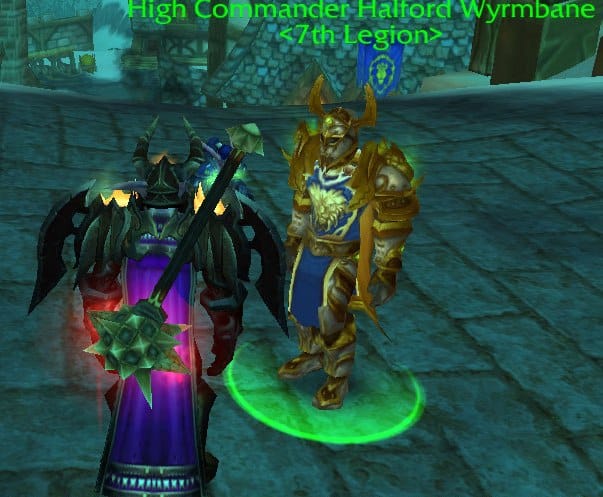
Halford Wyrmbane's 7th Legion holds Wintergarde Keep in a cemetery war under Naxxramas while Thel'zan directs the assault from the mausoleum.

What it hides

Thel'zan was Father Inigo Montoy, the traitor who absconded with Kel'Thuzad's phylactery. Dragonblight's war is compromised from within before Putress ever appears.

Toward Angrathar

Bolvar personally joins the final assault on the mausoleum in An End and a Beginning, then leads the northern push from Fordragon Hold.

From the War JournalAn End and a Beginning

Fault line II
The Scarlet Onslaught's False Crusade

Even the war against undeath has been infiltrated by its own enemy.

Before the gate

New Hearthglen wages a private holy war while Abbendis's diary exposes the movement's fanaticism and decay.

What it hides

Abbendis dies at the player's hand, while her patron, Grand Admiral Barean Westwind, slips away. Icecrown later unmasks him as the dreadlord Mal'Ganis.

Toward Angrathar

The Onslaught reinforces Dragonblight's central warning: uniforms and declared causes cannot tell you who is truly directing the war.

Fault line III
Wyrmrest and the Fractured Dragonflights

The temple symbolizes unity, while every surrounding shrine records a different form of collapse.

Before the gate

Alexstrasza forms the Wyrmrest Accord as mortals defend the temple and the five dragonshrines from necromancy, madness, and temporal interference.

What it hides

The blue flight is at war with mortal magic, the black flight is corrupted, and Chromie's Mystery of the Infinite exposes time-meddlers trying to derail history. The alliance is deeply incomplete.

Beyond Wrath

Wyrmrest stays a seat of dragon politics through the Dragon Soul crisis, Chromie's later investigations, and the return to the Dragon Isles.

From the War JournalMystery of the Infinite

Fault line IV
The Nexus War Cuts Across the Main Campaign

While armies march on Icecrown, another war is being fought over who may wield magic at all.

Before the gate

At Moonrest Gardens, a surge needle bores into a ley confluence while agents at Stars' Rest trace and sabotage the blue flight's operation.

What it hides

Malygos started this war. He is hunting mortal spellcasters and striking at the Accord from inside dragonkind itself.

Beyond Wrath

The conflict ends at the Eye of Eternity, and its grief persists through Kalecgos, Sindragosa, and Dragonflight's attempt to heal the Azure legacy.

From the War JournalTo Stars' Rest!

Fault line V
The War Beneath the War

The sinkholes near Icemist reveal that Arthas conquered a civilization before the player's campaign even began.

Before the gate

The Pit of Narjun opens into the broken empire of Azjol-Nerub as the Horde frees High Chief Roanauk Icemist from the Anub'ar's grip.

What it hides

The Scourge's northern power rests partly on the ruins of an older kingdom. The surface war is only the newest layer of conquest.

Toward Angrathar

Azjol-Nerub and Ahn'kahet turn Dragonblight into a vertical battlefield: armies march north while another defeated world stays trapped below.

Fault line VI
Arthas's Crime Replays Around You

Dragonblight forces the current expedition to walk through the story of the prince's descent.

Before the gate

The Forgotten Shore replays the landing and burning of the fleet, and Frostmourne Cavern reveals the moment Arthas takes the blade.

What it hides

His dead soldiers still do not understand their betrayal, while Muradin's survival reframes one of Warcraft III's defining moments.

Toward Angrathar

The march north doubles as a return to the scene of the crime, and at Angrathar, Arthas himself steps out to meet it.

From the War JournalFrostmourne Cavern

Fault line VII
Galakrond

The Scourge digs beneath for something large enough to change its chances of winning.

Before the gate

North of Wyrmrest, the Cult of the Damned excavates Galakrond's colossal remains, raising frost wyrms from the bones while trying to raise the progenitor himself.

What it hides

Grand Necrolord Antiok's own battle cry gives the operation away: "The Lich King demands more frost wyrms be sent to Angrathar!" This dig is air support for the battle everyone remembers.

Beyond Wrath

The skeleton belongs to the terror whose fall preceded the Aspects' elevation, and dragon storytelling keeps circling back to his shadow, from Dawn of the Aspects to the Infinite plots.

From the War JournalGalakrond and the Scourge → On Ruby Wings

Fault line VIII
The Blight

Venomspite makes sense of the events at Wrathgate. Horde players ran this weapon's supply chain themselves.

Before the gate

Forsaken apothecaries stabilize, transport, and field-test a weapon engineered to kill living and undead targets alike.

What it hides

The quests frame the research as ordinary military logistics. Only at the gate does Putress reveal the conspiracy.

After the rupture

The same weapon drives the Battle for the Undercity, then echoes through Southshore, the Siege of Lordaeron, and the long contamination of the Undercity.

Vikstone, night elf warrior of US-TerokkarVikstone's field read: catastrophes rarely begin at the moment everyone notices them.

Seat of the Aspects: Wyrmrest and the Shrines


At Venomspite, Horde players participate directly in the Royal Apothecary Society’s plague development program, field-testing the same blight that will later be deployed at the Wrathgate.

Moa’ki Harbor offers a quieter thread: tuskarr elders planning for a future they’re not sure will come.

Wyrmrest Temple stands at the zone’s center, the first time all five dragonflights appear united in-game. The political tension between Alexstrasza and Malygos plays out in NPC dialogue, and the Wyrmrest Accord reputation grind anchors one of Wrath’s most iconic mount rewards.

Chromie appears here too, continuing the Bronze Dragonflight’s quiet presence across WoW’s timeline. Her investigations in Dragonblight connect to threads that run from the Caverns of Time through Shadowlands.

And at the Obsidian Dragonshrine, players witness firsthand how far the Black Dragonflight has fallen, their corruption on full display in a graveyard meant to honor them.


Wyrmrest Temple: Nexus of Dragonflight Power

Wyrmrest Temple: Nexus of Dragonflight Power


At the heart of Dragonblight (≈59, 54), the titan-built Wyrmrest Temple rises over the Dragon Wastes, forged by the titanic keepers shortly after they empowered the five proto-dragons who defeated Galakrond. The Chamber of the Aspects anchors the lower levels; the Wyrmrest Summit crowns the spire. 

Five surrounding dragonshrines (Ruby, Azure, Emerald, Bronze, Obsidian) ring the temple in the land where dragons have come to die since time immemorial.

Wrath’s arc: Alexstrasza formalizes the Wyrmrest Accord here to counter Malygos and the blue flight’s Nexus War against mortal magic. On the ground, you act as a combat docent: Defending Wyrmrest Temple straps you to a red Wyrmrest Defender for aerial dogfights against azure drakes around the spire, then plunges you to destabilize the Azure Dragonshrine.

The Accord born here ends the Nexus War and becomes the template for later mortal-dragon cooperation (from Cataclysm’s crisis councils to Dragonflight’s renewed politics).


Wyrmrest Temple


Deeper lore notes:

  • Many legends say the Aspects were blessed within Wyrmrest; in truth, their elevation followed Galakrond’s fall at Galakrond’s Rest, but the temple still stands as the symbol of that charge.
  • The Scourge defiles the shrines during Wrath, raising frost wyrms from dragon bones; the reds recruit mortal champions to hold the line.
  • After the Nexus War, twilight dragon eggs are discovered in the Obsidian Sanctum below. Adventurers destroy them at Alexstrasza’s behest, prompting the black dragonflight’s retaliatory strike on the Ruby Sanctum, where Halion awaits.
  • Sindragosa’s crystalline essence is ultimately brought here to rest. Kalecgos receives it with the words: “So much suffering, so much needless destruction. These have not been kind times for my brothers and sisters. But thanks to your efforts, brave adventurers, this darkened yet still noble soul may find peace at last. Rest now, Sindragosa. You are home….”


Events after Wrath:

  1. Cataclysm: Wyrmrest is ground zero for the Dragon Soul raid; Morchok pounds the foundations while Deathwing’s forces lay siege. After the Aspects expend their power to destroy the Destroyer, the temple grows quiet.
  2. Thrall: Twilight of the Aspects: The Twilight’s Hammer seizes the temple; Korialstrasz’s apparent betrayal (actually a heroic sacrifice to destroy corrupted eggs) shatters Alexstrasza’s Orb of Unity. Thrall helps reunite the flights and retake their ancestral seat.
  3. Legion: Dragons still convene; the Ebon Blade interrogates bronze dragons here seeking Kyranastrasz’s remains, and Chromie’s Deaths of Chromie scenario threads through its halls. Halion doesn’t wait alone… his lieutenants Saviana Ragefire, Baltharus the Warborn, and General Zarithrian round out the Ruby Sanctum raid.
  4. Dragonflight prelude: When the Dragon Isles reawaken, dragons across Azeroth feel a strange pull in their hearts. They gather here at Wyrmrest, where Alexstrasza announces their ancestral homeland is calling them home.


Years later in Dragonflight, Kalecgos freed Sindragosa’s soul for real. Malygos and his Azure Queen walked into the afterlife together, hand in hand, and the road there started here: with a crystalline essence, and a grieving blue dragon’s promise at Wyrmrest.

The violent deaths of Malygos and Sindragosa had left both souls stranded, looping their final moments, and breaking that loop meant Kalecgos dueling Malygos himself while adventurers subdued Sindragosa, soothing them free rather than destroying them. Malygos apologized for the burden he left behind; Kalec answered that it wasn’t a burden but a legacy.

Venomspite: Field-Testing the Blight (Horde)


At Venomspite (76, 61), the Hand of Vengeance drafts you as an apothecary’s aide. Chief Plaguebringer Middleton hands over The Forsaken Blight and You: How Not to Die and sends you to the Forgotten Shore to siphon 10× Ectoplasmic Residue, the reactive agent that wakes his otherwise inert strain. 

He uncorks a vial, inhales deeply to prove the strain is inert, then explains that mixing it with the reactive agent would reduce everyone nearby to “shapeless piles of goo.” The stabilized payload is then housed in crystallized tears from dying green dragons at the Emerald Dragonshrine. Middleton’s offhand remark: “apparently they cry a lot right before they die”.

Where it leads: You run samples to the front: Spread the Good Word puts you in a Forsaken Blight Spreader bombing run over the Carrion Fields near Naxxramas, and The Forsaken Blight couriers Middleton’s final specimen to Doctor Sintar Malefious at Agmar’s Hammer (one of only two known Grand Apothecaries, alongside Putress). 

Side note: a Scarlet Onslaught Prisoner in Blighted Last Rites proves oddly immune to the “perfected” blight, prompting Apothecary Vicky Levine‘s disbelieving cry: “WHAT?! That’s impossible!”

Nobody ever explains the Onslaught’s resistance. Maybe a counter-agent, maybe the Light, maybe just a quest beat Blizzard never returned to. Either way it stands as the blight’s one confirmed failure, unaddressed to this day.


Why the Blight Isn’t the Plague

The Forsaken Blight is not the Lich King’s plague; it’s the Forsaken’s own weapon, engineered to kill living and undead alike (hence the gas masks) and potent enough to make even the Lich King reel. Venomspite is your first close-up before the Wrathgate, where Putress shells Horde, Alliance, and Scourge alike with the weapon they helped him build.


Venomspite


The Howling Fjord Forsaken Plague Development entry covers the blight’s origins and the full R.A.S. backstory. Here’s what’s new in Dragonblight:


Backstory and blowback:

  1. Northern pipeline: Early barrels shipped to Vengeance Landing degraded during the ocean crossing, reducing effectiveness. New Agamand shipped a perfected strain to Venomspite that proved too potent, prompting the “inert until ectoplasm” fix that you help source.
  2. Alliance interference: An Alliance theft lets Peppy Wrongnozzle (a drunk gnome alchemist at Westguard Keep attempting a vaccine) accidentally perfect a batch: her vrykul test subject melts into goo while she slurs, “I made thingsh worsh…I perfected their plague for them!”
  3. Aftershocks: Post-Wrathgate, the Horde bans full-potency use; weaker strains still see action (and prove literally explosive on Fenris Isle murlocs). Later, Southshore is drenched in a nastier brew, leaving the land uninhabitable for perhaps a century. By BfA, Lordaeron is blighted during the siege (Jaina’s frost magic disperses the airborne plague, but Sylvanas detonates reserves as the Alliance enters the throne room). By Shadowlands, the factions purge Undercity’s blight using plague eaters empowered by the House of Plagues in Maldraxxus, plague eaters that consumed the blight. The consumed blight and the eaters merged into an Amalgam, which the Forsaken destroyed to finally clear the contamination.

Tuskarr Lore at Moa’ki Harbor: “Planning for the Future”


At Moa’ki Harbor (≈ 48, 74), the Kalu’ak greet you with kite-bright skies, fish smoke on the wind, and storytellers holding court on the quay. Near the inn entrance, Trapper Mau’i offers the daily Planning for the Future, a rescue of Snowfall Glade pups from the wolvar. 

What it says about the Kalu’ak: Mau’i’s line is the thesis: the wolvar “have as much right to exist as do we.” The sentiment is druidic (guard the small, mend the world), but the delivery is pure tuskarr: family first, everything else second. Kite-flying is a genuine cultural pastime, and those bright shapes overhead signal a community persisting through troubled times.


Moa'ki Harbor


Elder voices: Afterward, Elder Ko’nani (Moa’ki’s chieftain) puts your pup rescue in context. His fireside gossip stitches Dragonblight’s upheaval together: “The Dark One rides forth again with his San’layn, the dragons fight in their great Nexus War, and the vrykul are reawakened. Your people sail north on your wooden ships to fight them and one another.” 

The sting is in the tail: “your people sail north to fight them and one another.” The Kalu’ak see both wars, and they’re caught in the middle of both.


Spirits of the sea: Piety here flows seaward. The chain culminating in Conversing With the Depths sends you, via Toalu’u the Mystic, to the Briny Pinnacle to commune with Oacha’noa, the goddess of wisdom, a kraken-shaped sea deity.

She’s suspicious at first (“Are you working with the trolls of this land? Have you come to kill me and take my power as your own?”), a reference to the Drakkari who sacrificed their loa for power against the Scourge. She’s right to worry. In Zul’Drak, you’ll watch the Drakkari butcher their own gods one by one to fuel a losing war against the Scourge. Oacha’noa knows what’s happening next door.

To prove yourself, she lays what she calls “a mild compulsion” on you: jump into the depths, into her element, as a display of submission. Then comes the line that makes the whole encounter: “Though you are compelled, the choice, and the last step before you leap, are yours. You have twenty more seconds to decide.” Refuse, and she dismisses you with “Do not call upon me again until you have found your backbone!” A goddess who compels you and then insists the leap is still yours: that’s more theology in three lines of 2008 quest text than most zones manage in total.


Taunka Compel, Tuskarr Befriend: Seen beside the taunka, who forcibly bend nature and the elements to their will to survive, the Kalu’ak philosophy stands apart: where taunka compel, tuskarr befriend. 


Harbor as crossroads: Moa’ki is the tuskarr’s largest remaining port after Kaskala, their former capital in Borean Tundra, fell to the kvaldir. It’s also the ferry hub of Northrend’s west coast: the giant turtle Green Island plods to Kamagua (Howling Fjord), while Walker of Waves continues to Unu’pe (Borean Tundra).


After the long wars: In the years following the Jailer’s defeat, the Bronzebeard brothers stopped here, trading questions for fresh-caught fish. Elder Ko’nani recalled their forebear Mina Stormsmith passing through five hundred years ago, a dwarf who fought like she didn’t care if she lived or died, hiding a great grief behind rage. The tuskarr thought her one of the earthen and pointed her toward titan-haunted Sholazar, one more traveler braided into Moa’ki’s memory nets.

Chromie’s Temporal Investigations and the Bronze Thread Through WoW


From Chromie atop Wyrmrest Temple, you’re sent to the Bronze Dragonshrine (≈ 72, 39) for Mystery of the Infinite. You plant the Hourglass of Eternity and fight off Infinite drakes, first with Future You, then (in Mystery of the Infinite, Redux) you return to aid Past You.

The shrine becomes a paradox you can walk through (and a crime scene).

Chromie (aka Chronormu) has long favored her gnomish visage (established back in Andorhal’s “A Matter of Time“). Dragonblight is where Wrath’s time-travel mechanics first click: closed loops, self-aid, fixed events. You interact with fixed points while foreshadowing Culling of Stratholme (CoT) and the later reveal that the Infinite Flight’s master is a future Nozdormu: Murozond.

The Bronze were charged by Aman’Thul to guard the one true timeline. Nozdormu himself warns: “Time is a tangled web. Try not to dwell on all the loose ends.”


Mystery of the Infinite


Chromie’s Case File (Classic → The War Within):

  • Classic (Andorhal). Runs a time pocket in the inn; has you harvest trinkets of time, build dampeners for Araj, and stage the Battle of Darrowshire reenactment. Early hands-on timeline repair.
  • Wrath of the Lich King. Your Wyrmrest/Dragonshrine loop + CoT: Culling of Stratholme, where Chromie equips you to expose plagued grain and keep Arthas on-rails.
  • Cataclysm. Cameos as a whelp helper in Hyjal during The Protectors of Hyjal; pops up after Well of Eternity; later in Stormwind with a Fragment of Deathwing’s Jaw to let Alliance players replay Dragon Soul.
  • Mists of Pandaria. As a Timewalker, she points you toward the Timeless Isle, a pocket where chronology puddles instead of flows.
  • War Crimes (novel) → Warlords of Draenor. Works the Vision of Time during Garrosh’s trial; gets jailed during Kairoz‘s jailbreak; on alt-Draenor, helps track Kairoz to the Time-Lost Glade and face his spirit.
  • Legion – “The Deaths of Chromie.” A repeatable, 15-minute mystery: hop timelines (Stratholme, Andorhal, Hyjal, Well of Eternity) to stop synchronized assassinations at Wyrmrest. It’s Chromie as both victim and case officer, with you as her paradox partner.
  • Battle for Azeroth. Visits Mechagon to scan machine-ruined futures; later joins other dragons to empower the Heart of Azeroth in the Chamber of Heart.
  • Shadowlands. Her name becomes a feature: “Chromie Time,” the system where she personally manages which expansion new characters level through, making her the only NPC with a game mechanic named after her. Bronze business otherwise stays in the background while Maldraxxus and friends handle death’s politics.
  • Dragonflight. Front-row Bronze arc: at the Temporal Conflux confronts Eternus, vows to find another way for Nozdormu; at Eon’s Fringe unmasks Morchie (an Infinite-Chromie). In Dawn of the Infinite, you enter a timeline where Nozdormu has already fallen to become Murozond and Iridikron is siphoning Galakrond’s essence to power the Incarnates’ war. Chromie helps you break the loop and pull Nozdormu back from the edge.


Who she is:

  • “Visage Day.” Canon short story: Chronormu chooses a female gnome form because “it suits me”, a personal choice that explains Chromie’s approachable style among mortals. Chronormu’s true draconic form is male. The gnomish woman named Chromie is a deliberate choice, which is what makes “Visage Day” a story about identity rather than just a costume change.
  • Old friends. Zidormi (bronze time-keeper you meet near phased zones) is a close confidante in that story; Kalec encourages the approachable-visage idea.
  • Running gags. Dalaran fountain coin: “Just once, I wish someone would greet me without making a stupid joke about gnomes or time travel.” Also: lots of spare pocket watches, and in Wrath, your Future You confides: “Listen. I’m not supposed to tell you this, but there’s going to be this party that you’re invited to. Whatever you do, DO NOT DRINK THE PUNCH!”
  • Forms through eras. Shows up as whelp (Hyjal/Legion), drake (WoD/Dragonflight), full-grown dragon (Wrath) – her when often dictates her what.

Obsidian Dragonshrine: Corruption of the Black Flight


Where & what: (~38, 31) at the mouth of the Maw of Neltharion. With the black dragon Serinar, you descend into lava-veined tunnels to smash Scourge rites, stamp out necromantic runes, and (the capstone) ignite Neltharion’s Flame to sear a summoning pit and kill Rothin the Decaying. 

The dismissals are the tell. Serinar’s parting words: “You can leave now. Go tell Nalice she missed out on a good slaughter.” Nalice’s, when you do: “Are you still here? I’m done with you.” No thanks, no pretense of alliance; you were useful, briefly, and both of them want you to know it.


The Best of Intentions

The Best of Intentions


Quest spine: The Obsidian Dragonshrine → No Place to Run & No One to Save You → The Best of Intentions → Defiling the Defilers & Culling the Damned → Neltharion’s Flame → Tales of Destruction (Serinar, Maw of Neltharion). You burn dragon remains so they can’t be “toyed with again.”

The shrine spotlights the black flight’s fall from earth-warders to willing corrupters. Wrath seeds the bigger arc here: beneath Wyrmrest, Sartharion tends twilight eggs in the Obsidian Sanctum, a direct line to Sintharia/Sinestra’s experiments at Grim Batol and the Twilight Dragonflight that erupts in Cataclysm.

Design echo: These lava tubes and corpse-forges are the overworld prelude to the Obsidian Sanctum raid: you can even tune difficulty by leaving Shadron, Tenebron, Vesperon alive (“OS3D”) for a nastier Sartharion. And better spoils.


Lore details:

  • Original charge → fall. The blacks were Khaz’goroth’s earth-warders (“deep places,” true strength from the earth). Old God whispers twisted Neltharion into Deathwing, inverting that duty and setting his flight against life.
  • Wyrmrest politics. During Wrath, black envoy Nalice sits in the Wyrmrest Accord, and she’s the one who sends you to Serinar, sneering that the red flight’s “good graces” apparently don’t extend to anyone else’s shrine (“Surprised? I’m not.”). Serinar’s greeting completes the picture: he can’t decide what surprises him more, that you’d aid a black dragon or that you “survived speaking with Nalice,” adding that “Wyrmrest can keep even our kind in check sometimes.” The Accord isn’t harmony, it’s a leash both dragons openly resent.
  • Sanctum → Ruby bridge. After you crack the Obsidian Sanctum, the flight retaliates in the Ruby Sanctum with Halion, making Dragonblight the staging ground for the red–black war that spills straight into Cataclysm.
  • Bone-fire logic. Burning remains; Scourge necromancy and twilight cultists both repurpose draconic corpses
  • Names & symbols. “Obsidian” is the black flight’s older byname; their sigil is a volcano, earth’s might weaponized after their fall.
  • Long tail. Far down the timeline, the flight tries to right itself: Sabellian’s uncorrupted Obsidian Brood returns from Outland, Wrathion leads the Blacktalon, and in Dragonflight, the brothers yield to Ebyssian as the new Aspect, an attempted restoration of the original earth-warder creed.

Bones and Betrayals: Galakrond to the Wrathgate


Galakrond’s Rest holds the bones of the first and largest proto-dragon ever to exist. Before the Titans elevated the Aspects, Galakrond terrorized primitive Azeroth, consuming other proto-drakes and growing to a size that dwarfs anything players encounter in-game. 

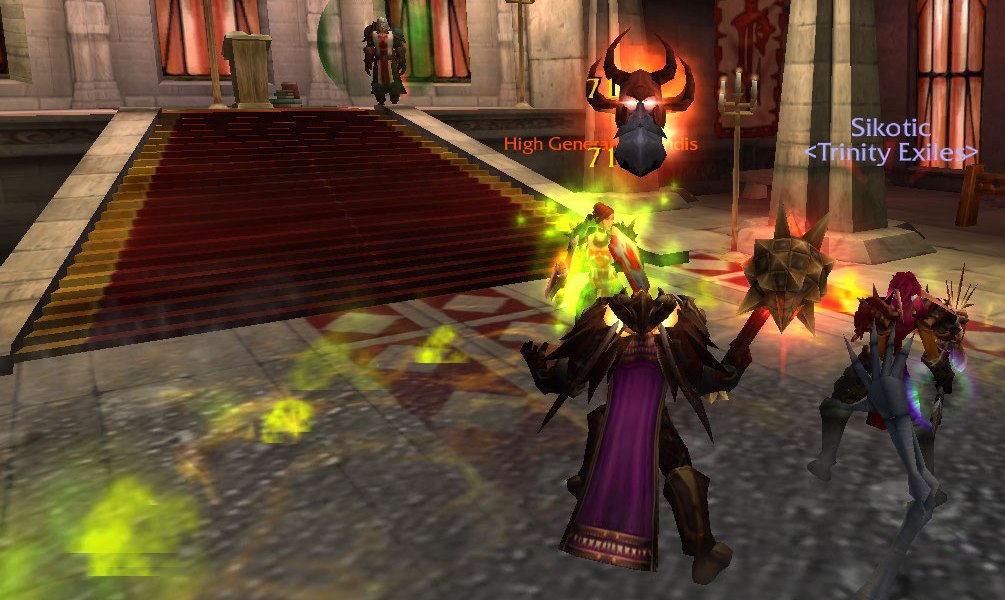
The Diary of High General Abbendis is one of WoW’s darkest readable items. Found during the Scarlet Onslaught questline, her journal entries document the slow corruption of faith into fanaticism. 

Angrathar the Wrathgate needs no introduction for anyone who played Wrath at launch. The cinematic, the betrayal, the aftermath in Undercity.

The Pit of Narjun opens into Azjol-Nerub’s upper reaches, the first glimpse of the Nerubian empire that players later descend into. And the Ruby Dragonshrine shows Alexstrasza’s flight under siege, red dragon eggs corrupted and the Life-Binder’s sanctuary turned into a battlefield.


Galakrond’s Rest: Bones of the First Terror

Galakrond’s Rest: Bones of the First Terror


Where (≈ 47.2, 49.1). In the middle of Dragonblight’s Dragon Wastes sprawls a skeleton so vast it becomes the landscape: the ribcage of Galakrond, the cannibal “progenitor of dragonkind.”

The Aspects deliberately spread the myth that they were created from Galakrond, the “Father of Dragons,” to prevent other proto-dragons from following his cannibalistic path. The bones you’re standing in belong to a monster the dragons wanted everyone to worship instead of imitate.

This is where five proto-dragons, Alexstrasza, Malygos, Nozdormu, Ysera, and Neltharion, first fought as one to bring him down, a battle later told in full in Dawn of the Aspects. Their victory led the titans (through their keepers) to empower the five as Dragon Aspects, an origin that predates the Sundering.

The ribs form natural aisles; cult tents and dig tools dot the snow; bone shards the size of ballistae jut from the ice. Stand beneath the sternum and the scale clicks: every “dragon” you’ve met fits inside this chest.


Galakrond's Rest


Why this site matters:

  • Where the Five First Stood Together: These bones mark the first time the five stood together… and foreshadow the shattering that followed when Neltharion became Deathwing.
  • From myth to masonry: In Galakrond’s wake, the keepers forged Wyrmrest Temple in ancient northern Kalimdor (today’s Dragonblight) as a council hall, exactly the tower you defend throughout Wrath.
  • The canon note: Older summaries sometimes place the empowerment “at the Well of Eternity.” Modern tellings confirm: the Aspects were blessed near where Galakrond fell, not within the temple itself.


The exhibit (Wrath arc):

  • Scourge & Cult intrusion: During the Northrend war, the Cult of the Damned tries to excavate the corpse and raise Galakrond as a frost wyrm. You and the Wyrmrest Accord intervene, cutting down necromancers, disrupting rituals, and ultimately slaying Grand Necrolord Antiok, who commands from the Wicked Coil atop the reconstructed storm giant Thiassi, before Galakrond can be raised. Antiok’s battle yells reveal where the operation’s output is going: “The Lich King demands more frost wyrms be sent to Angrathar!” The wyrms raised from these bones are being shipped to the Wrathgate. When you disrupt this dig, you are thinning the air cover for the battle everyone remembers.
  • Echo of Warcraft III: The plan relies on Arthas raising Sapphiron, who later guards Naxxramas, but scaled to apocalyptic size. 


Dragonflight connections:

  • Uldaman mural: A watcher-carved fresco of Galakrond’s fall reappears in Uldaman: Legacy of Tyr. The titans recorded this death. Tens of thousands of years later, you’re standing in it.
  • Dawn of the Infinite: You witness Galakrond’s fresh corpse in the past as the Infinite flight attempts to warp the moment; Iridikron siphons Galakrond’s essence into a vessel Chromie describes as “kind of like the Dragon Soul, but even more ancient”, tying this grave to the Primalist plot and Nozdormu’s Murozond crisis.
  • The War Within: Void rifts now appear at the Rest due to the Dark Heart‘s power; Alleria Windrunner investigates alongside adventurers.


Quick lore bites:

  • Size & sickness: Galakrond grew so vast and corrupted through cannibalism that his victims rose as undead “not-living“; his breath became a sickly green “slow death.” Some lore scholars speculate Yogg-Saron’s pervasive corruption in Northrend may have accelerated Galakrond’s descent, but Dawn of the Aspects attributes it to cannibalism alone
  • Keeper Tyr’s cost: In the proto-dragons’ early battles here, Tyr lost his hand to Galakrond’s jaws, a detail resurfacing with the Spark of Tyr and Dragonflight’s Keeper threads. Watcher Jotun later forged his silver replacement.
  • The choke: In the final fight, Malygos lodged a boulder in Galakrond’s throat; his ice breath kept it stuck, then Neltharion blasted a not-living into it, forcing the stone deeper. Galakrond choked to death, an end that undercuts any temptation to worship the monster.

Diary of High General Abbendis: A Crusade Written in Blood


On the top floor of New Hearthglen‘s commanding manse (≈ 68, 76), a bedside book, The Diary of High General Abbendis, waits. 

It’s the unpolished source behind the pamphlet The Path of Redemption (and the Alliance breadcrumb of the same name). In her own hand, High General Brigitte Abbendis writes of “visions” calling her north, of “purity” burning away a “great shadow,” and she lauds Admiral Barean Westwind, who later unmasks in Icecrown as Mal’Ganis. The diary is the Scarlet Onslaught‘s manifesto before the press office edits it.


My Old Enemy

My Old Enemy


Why this one book matters:

  • Genesis of the Onslaught. You can see Brigitte’s private zeal harden into public doctrine: the diary → the pamphlet → the pulpits at New Hearthglen. It’s propaganda made on a nightstand.
  • The demon’s hand. Her glowing trust in Westwind/Mal’Ganis frames the entire Dragonblight → Icecrown Scarlet plot as a dreadlord-run crusade that weaponizes faith.
  • Quest framing. For the Horde, acquiring the diary completes The Truth Will Out; for the Alliance, a printed version, The Path of Redemption, drops from Onslaught soldiers at Base Camp. Both chains lead to My Old Enemy, the capstone that puts Abbendis down. Stay for the scripted epilogue: Westwind appears, kneels beside her corpse, and delivers the Onslaught’s true eulogy: “You served your purpose.” Then he laughs and teleports away, promising, “I will see you in Icecrown, weakling… if you live that long!” The diary’s glowing trust in the Admiral, answered. Everything the book confesses, the death scene confirms.


The Abbendis Line (Father and Daughter)

Older sources once mentioned a male High General Abbendis. That’s Brigitte’s father, High General Abbendis, a Silver Hand paladin and one of Alexandros Mograine‘s battlefield commanders at Blackrock Mountain. In the chaos of the Third War, he:

  1. Helped rally Silver Hand remnants, allied with Tyr’s Hand, and alongside Grand Inquisitor Isillien, Saidan Dathrohan (secretly Balnazzar), Renault Mograine, and Taelan Fordring – founded the Scarlet Crusade.
  2. Led the Crusade’s military arm from Tyr’s Hand (“the arm”), while Isillien ran the inquisitors from the Western Plaguelands (“the heart”). Their rhetoric turned into intolerance of “lesser races,” and battle trauma slid into zealotry.
  3. Died at Hearthglen, mortally wounded while saving Brigitte, who then inherited his rank and legacy.


Brigitte left behind more than her father’s legacy. Her daughter Lynnia Abbendis stayed in the Eastern Plaguelands when Brigitte sailed north. Lynnia appears to have fallen to the Plague of Undeath, which means the High General who writes about “cleansing” and “purity” may have lost her own child to the very corruption she crusades against.

Brigitte’s Northrend diary is hers, not her father’s. The Ashbringer comic is the piece that reconciles the two High Generals.

Brann’s footnote: Brann Bronzebeard once quoted the elder Abbendis promising, “Give it… two years and humans will hold Lordaeron; if not, I’ll buy you an ale.” Brann never got that ale.


Reading the diary:

  • Tell-tale vocabulary. “Purity,” “cleansing,” “destiny.” Classic Scarlet vocabulary. It always precedes atrocity.
  • The “vision” pipeline. Personal revelation → printed tract (The Path of Redemption) → homilies.
  • Continuity of manipulation. The elder Crusade was infested by dreadlords (Balnazzar wearing Dathrohan). The Onslaught reprises the trick with Mal’Ganis as Westwind. Same playbook, new theater.

Angrathar the Wrathgate: Scars That Never Heal


On Dragonblight‘s northwest rim, a knife-edged saronite wall bars the pass into Icecrown: Angrathar, the Wrath Gate. 

After you view the in-game cinematic, the hillside permanently phases to its aftermath; ashen soil, toppled standards, and eerie quiet where the Alliance (Fordragon Hold) and Horde (Kor’kron Vanguard) once stood shoulder to shoulder. Wrath used new tech here to lock in consequences and kick off the follow-up Battle for the Undercity. I wrote the full story of this moment, the cinematic, the betrayal, and what it meant to watch it in 2008, in my Wrathgate post. This entry is the field guide to the place itself: what the ground remembers after everyone else logged off.


The Battle For the Undercity

The Battle for the Undercity


Why it matters: Grand Apothecary Putress unveils the Forsaken blight (“Death to the Scourge! And death to the living!”), shattering the truce. Alexstrasza‘s red flight arrives in a storm of cleansing fire, but too late: Bolvar Fordragon survives, irrevocably changed, and will one day accept the Helm; Dranosh Saurfang falls here, then returns as Deathbringer Saurfang in Icecrown Citadel.

The events that took place here altered the course of history for WoW’s central characters.


How you reach the Gate (both factions):

  1. Horde unlocks wind through Westwind Refugee Camp (Into the Fold), Agmar’s Hammer (Strength of Icemist chain), and Venomspite (The Forsaken Blight and You: How Not to Die). Then Overlord Agmar sends you to The Kor’kron Vanguard!, the jump to Wrathgate.
  2. Alliance unlocks run via Wintergarde Keep (Naxxramas and the Fall of Wintergarde), Wintergarde Mine, and Into Hostile Territory in the mausoleum.
  3. Watch the cinematic, earn Veteran of the Wrathgate, and your world phases to the scorched aftermath, your trigger for the Undercity assault chain.


What to notice:

  • Phased terrain as narrative: the battlefield remains burned and depopulated after the cutscene, a system invented in Burning Crusade as a quiet bug-fix that Wrath turned into open-world storytelling, the story state persists after the cutscene.
  • Red-dragon “cleansing”: lore notes the reds burned plague and undead alike; grass and flowers briefly returned where flame fell, later glaciated as Northrend reclaimed the slope. The Bronzebeard brothers’ post-Shadowlands report confirms ice now covers that brief bloom.
  • The wall itself: a saronite bastion of razors and spires, mirrored left/right. The gate is explicitly crafted to look like the Helm of Domination, TCG flavor text confirms it outright. The wall itself is saronite, which the tuskarr call the “Black Blood of Yogg-Saron.” The gate to Icecrown is built from an Old God’s remains. Even the architecture is corrupted before you walk through it.
  • Jurassic Park Easter Egg — Varimathras‘s “Clever girl…” comment: During the Horde version of The Battle For The Undercity (the phased assault that follows Wrathgate), there’s a sly pop-culture reference: Sylvanas calls the halt (“HOLD! I sense dark magic. Demon magic… Stand ready!”) and Varimathras answers with “Clever girl…”, game warden Robert Muldoon’s last words in Jurassic Park (1993). Blizzard even kept the line’s function: Muldoon says it moments before the raptors take him, and Varimathras says it at the top of the fight he doesn’t survive.
  • Rewatchable moment: speak to Alexstrasza (with Korialstrasz) on the blackened field to replay the cinematic. Alexstrasza speaks in Draconic after the event. The line was never meant to be readable in-game, but its meaning leaked into the lore community: “They must not discover the fate of the young paladin. Not yet.”


Reborn From the Ashes

Reborn From the Ashes


Curator’s thread:

  • Weapon revealed: Putress’s blight is neither Scourge plague nor one-off gas. It’s the Forsaken’s perfected strain, lethal to living and undead. Wrathgate is the public test; Undercity is the fallout.
  • Character arcs seeded:
    • Bolvar + red fire + plague immunity → the hidden survivor who later dons the Helm. The flames “charred him beyond recognition” but kept him in a state between life and death, neither fully alive nor truly dead. His survival was teased twice before Icecrown Citadel confirmed it: the hidden Draconic line on this very field, and a vision in the Ulduar raid (patch 3.1) where the Lich King tortures an unbroken Bolvar, months before the reveal.
    • Dranosh → Deathbringer Saurfang, described as “the Lich King’s most powerful death knight.” In the ICC raid, his father Varok comes to collect his body. “My boy died at the Wrath Gate.”
    • Forsaken schism: Putress’s treason (in league with Varimathras, who’d secretly remained loyal to the nathrezim and Burning Legion) turns a “Horde victory” into a civil war beat.

Pit of Narjun: Mouth of the Spider Kingdom


Southwest of Icemist Village (≈ 26.1, 49.7), a sinkhole drops you into the upper arteries of Azjol-Nerub. For many players, it’s the first descent, made while hunting Black Blood of Yogg-Saron, for the blacksmith Borus Ironbender, who watched the Wrathgate’s metal “pulse and undulate as if it were alive” and admits: “In 50 years I’ve never seen metal ‘breathe.’ Only ones who knew anything about it were the tuskarr.” Their name for it: the Black Blood of Yogg-Saron. The ore that whispers madness, and the pit is rich with it.

The galleries here web outward toward Ahn’kahet: The Old Kingdom, where the nerubians’ flight from the Scourge literally bored into Old God territory.


Azjol-Nerub


Why it matters:

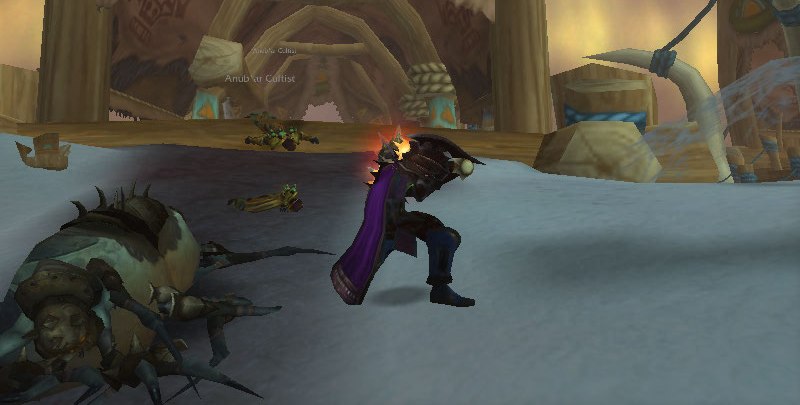
  • A fallen empire. Nerubians are the northern heirs of Azj’Aqir; the Aqir and Troll War‘s sundering birthed Azjol-Nerub (north), Ahn’Qiraj (southwest), and the mantid empire (southeast). Their underground civilization (libraries, art, and philosophy; scholars more than smiths) once spanned half of Northrend.
  • The Scourge parasite. In the War of the Spider, Ner’zhul overwhelmed the kingdom; its last king, Anub’arak, fell and rose as the Traitor King (your dungeon finale). Blizzard’s own developer described the cancelled zone as having “buildings, temples, a look and feel very similar to Naxxramas, since the nerubians are where the Scourge stole that architecture from.” Every zigzag spire and web-strung archway in Naxxramas was borrowed from the kingdom it helped destroy.
  • An older rot beneath. Saronite, the Scourge’s “miracle metal,” is the congealed blood of Yogg-Saron. The ore’s whispers, the Faceless Ones in the deeps, and the sanity-shearing geometry of Ahn’kahet all flow from that fact. The nerubians dug too deep, fleeing the Scourge and exposing “a tendril of the Old God’s will”, leaving them trapped between two fronts.


What to look for:

  • Architectural palimpsest: chiseled, facet-cut corridors (nerubian craft) overrun by Scourge scaffolds and saronite veins.
  • Sound design tells the story: distant chittering, wet stone, and whisper beds when you near Old-God growths. Ahn’kahet whispers to players at random: “Trust is your weakness… Hope is an illusion…”
  • Route logic: Narjun → Azjol-Nerub (Upper Kingdom) for the Scourge war; Narjun → Ahn’kahet (Old Kingdom) for the Old-God infestation. Two dungeons, two threats, one wound.


Design echo: Azjol-Nerub was once pitched as a full subterranean zone (wall-climbing mounts and all) before becoming two 5-mans; Ghostcrawler later called it “the zone I am personally saddest about cancelling.” Narjun lets you feel that cut-content scale. 

Pop-culture echo: The Pit of Narjun invites a comparison to the Great Pit of Carkoon from Return of the Jedi (1983). Both are desert/wasteland sinkholes housing something ancient and hungry.


Aftermath & epilogue:

  • Wrath era: Living nerubian holdouts (e.g., Kilix the Unraveler) wage a guerrilla war topside while you cleanse tainted egg clutches below. The pit served as the Anub’ar invasion route when undead nerubians overran Icemist Village.
  • Later: The Argent Crusade plants the Crusaders’ Coliseum over the northern reaches. The Lich King mocks Tirion for building over his conquered kingdom. Post-Lich King, nerubians under Seer Ixit speak of hidden egg caches to re-seed their people: “The rebirth of the Empire of Azjol-Nerub is upon us!”

Ruby Dragonshrine: Hearth of the Life-Binder


On Dragonblight’s snowfields, the Ruby Dragonshrine is a warm island of life. Lore says a single drop of Alexstrasza‘s blood sank into the drifts and grew into the Crimson Oak at its heart, a legend Nozdormu himself confirms.

Perfect for a flight whose fire can nurture or destroy.

In The Fate of the Ruby Dragonshrine, you aid red keepers against Scourge desecration and mourn the grove’s fallen keeper, Dahlia Suntouch, a high elf slain by the death knight Orbaz Bloodbane, then raised as a banshee, corrupting the very shrine she once protected. Egg-nests and incubation alcoves ring the grove, clear, in-world staging for the red flight’s charge to protect and propagate life.

Her freed spirit: “My time is done… I offered myself to Alexstrasza in life, but I have nothing left to offer in death. She will need a new keeper for her shrine. And thank you… thank you for freeing me from the shackles of the damned.”


The Fate of the Ruby Dragonshrine

The Fate of the Ruby Dragonshrine


Why it matters: Alexstrasza’s brood stands between life and annihilation. Reds form the Wyrmrest Accord to oppose Malygos’s Nexus War, and at Angrathar, their flame purges Putress’s blight from the dead and the living, leaving grass and flowers to grow where plague once festered.

The quest Dahlia’s Tears confirms the principle, and deepens it: Alexstrasza sends you to collect a flower that grows only in soil freshly cleansed by a Ruby Keeper’s flame, and she sends you for it as her offering in the search to save Crusader Bridenbrad, the dying paladin of Icecrown. Her words on granting it: “In this dark time, I’ll not be the one to abandon a champion of the Light.”

The flower carries the murdered keeper’s name; the soil it grows from was purified by fire, and it’s dispatched as hope for a man beyond saving. What the shrine’s keepers do at a garden scale, the red flight did at the Wrathgate on a battlefield scale, and what the Wrathgate did for a battlefield, one flower tries to do for one man.


Threads & echoes:

  • Ruby Sanctum (beneath Wyrmrest). Later, Halion‘s Twilight vanguard breaches the red sanctum and slaughters its guardians. Only Xerestrasza survives to send you in: “They slaughtered us with cold efficiency, but the true focus of their interest seemed to be the eggs.” It’s the same fight, pushed underground: protect the brood or lose the future.
  • End Time. One timeline shows a ruined, lifeless Ruby Dragonshrine haunted by the Echo of Sylvanas: “a maddened fragment… unable to find peace, aching to unleash her dark fury at anything still living.”
  • Day of the Dragon resonance. The grove’s “life amid winter” theme mirrors Alexstrasza’s arc after her liberation from Dragonmaw bondage, forced by Nekros Skullcrusher and the Demon Soul to breed war mounts, then freed by Rhonin and Krasus.


Lore details to notice:

  • Crimson Oak = blood oath. The oak grew from the Dragonqueen’s own blood. The shrine is built around a wound that became a garden.
  • Funeral flames. Reds practice sanctifying fire that denies necromancy; you’ll see that logic in quests that cleanse remains and ward eggs. The shrine is simultaneously a graveyard and a nursery.
  • Field commanders. Ceristrasz (Alliance) and Vargastrasz (Horde) are the red flight’s pragmatic quartermasters here, the same flight also deploys at Wyrmrest and Amber Ledge.
  • Life vs. Twilight. From Sinestra‘s twilight experiments (Halion was “raised in captivity from eggs created by Sinestra”) to the Ruby Sanctum breach, the black/twilight obsession with perverting broods makes the Ruby grove a perennial target.
  • Iconic intervention. The red flight’s Wrathgate flyover (“cleansing by flame”) is the macro-version of what the Ruby keepers do here every day.

Frostmourne’s Shadow: Arthas and Hidden Echoes


Frostmourne Cavern is where Arthas sealed his fate. The quest chain lets players retrace his final steps before claiming the runeblade, complete with ghostly echoes of Muradin’s warning.

Blizzard buried a Princess Bride reference in Dragonblight’s Scourge storyline. The Thel’zan reveal plays on one of the film’s most quoted lines, a dark joke hidden inside an otherwise grim undead narrative.

Jotun draws his name directly from Norse mythology, where the Jötnar were the giants who warred against the gods. His presence in Dragonblight connects to the titan-forged lore.

Wintergarde Keep’s projection room offers something rare: a military briefing about Naxxramas. Before you ever zone into the raid, NPCs here lay out the threat, the layout, and the stakes.

And the Emerald Dragonshrine sits in quiet contrast to its corrupted siblings. Ysera’s domain remains untouched by the Scourge, but the Nightmare’s influence is already visible at the edges, foreshadowing a threat that wouldn’t fully pay off until later expansions.


Frostmourne Cavern: Echoes of Arthas's Past

Frostmourne Cavern: Echoes of Arthas’s Past


Slip through the ice fissure on Dragonblight’s north wall (73, 23) to the chamber where Frostmourne once stood upright in its frozen altar. 

The game restages the Warcraft III moment as a spectral flashback, Muradin Bronzebeard kneels to read the dais inscription, calls the blade cursed; Arthas Menethil drops Light’s Vengeance and chooses power. 

The walls glitter with saronite (Yogg-Saron’s “black blood,” explicitly confirmed in the cavern’s design), a visual tie between the Lich King and the Old God imprisoned beneath Northrend, a connection Blizzard later confessed to fumbling. In a 2010 Game Informer postmortem, a developer admitted the Yogg-Saron/Lich King tie-in was fully intended, “In our minds that connection existed and was clear. We just didn’t do a very good job of expressing it.”

The Scarlet Onslaught later threw up a half-finished redoubt at the mouth and gave the cave its modern name.

This is Wrath’s direct connection to the Arthas saga (Warcraft III and Arthas: Rise of the Lich King): Muradin’s “death” (and later amnesia-clouded survival), Arthas’s fall, and the sword that will unmake kingdoms.


Frostmourne Cavern

Frostmourne Cavern


Lore threads the cave ties together:

  • Origin: Domination Magic. Later lore reveals Frostmourne (and the Helm of Domination) were forged in the Maw by the Runecarver, later revealed to be the imprisoned Primus, under the Jailer’s will; nathrezim ferried them across the veil to Azeroth and bound Ner’zhul to them. Frostmourne is a true mourneblade, runed with Domination; a conduit of the Maw, forged to bind will itself.
  • At the Third War, the cavern was guarded by revenants led by the Guardian, whose dying words to Arthas are among WC3’s most quoted: “No… trying to protect you… from it.” He wasn’t defending the sword; he was defending everyone from the sword.
  • Ner’zhul’s lure. From the Frozen Throne, he thrust Frostmourne into this cavern to await a champion. Arthas arrives with Muradin; the dais inscription (“Whomsoever takes up this blade shall wield power eternal. Just as the blade rends flesh, so must power scar the spirit.“) is read; shards of ice strike Muradin; Arthas claims the runeblade, and his soul is forfeit.
  • Wrath payoffs.
    • Halls of Reflection: Frostmourne floats alone above an altar; Uther’s spirit warns that “there must always be a Lich King“; another must take Arthas’s place lest the Scourge wash over the world “like locusts.” This seeds Bolvar’s ending. Uther says also: “You have forged this blade from saronite, the very blood of an old god. The power of the Lich King calls to this weapon.”
    • Fall of the Lich King: Tirion Fordring shatters Frostmourne with Ashbringer, releasing the souls trapped within. They swarm and immobilize the Lich King while Terenas’s spirit resurrects the fallen heroes to deliver the killing blow.
  • Legacy of the Shards. In Legion, frost death knights reforge Frostmourne’s fragments into the Blades of the Fallen Prince (Icebringer & Frostreaper), but only after subduing and bending the lingering remnants of Arthas and Ner’zhul within.
  • Shadowmourne circle. Darion Mograine sends you back here in WotLK to retrieve Light’s Vengeance, the hammer Arthas discarded in this very cave, as the first step toward crafting Shadowmourne, but the Lich King predicted this: “Did you truly expect to fulfil Mograine’s task unopposed?” He raises hordes of ghouls and your way out is the hammer itself: the ghouls fall to Light’s Vengeance, swung by the hand Arthas never imagined would hold it.


Years later, the Bronzebeard brothers returned. Muradin’s weapons from that day were still frozen in the ice. When Brann tried to chip them free, Muradin stopped him: everything he carried from those days should stay here. Let this remain a grave undisturbed.

“The Princess Bride” → Thel’zan Reveal


The Alliance’s Wintergarde finale, An End And A Beginning, sends you into the Wintergarde Mausoleum to destroy Thel’zan the Duskbringer, who is unmasked by Bolvar Fordragon himself as Father Inigo Montoy, the “Brotherhood of the Light” priest from Classic. 

His name is a wink at The Princess Bride‘s Inigo Montoya, and the reference goes further than the name. Fish Inigo’s Copper Coin from Dalaran’s fountain, and you’ll read “I wish I had my father back…“, an echo of Montoya’s famous revenge climax.

The community has long debated whether the connection runs even further. In the film, Montoya’s entire arc is avenging his murdered father. If Kel’Thuzad killed Montoy’s father, then stealing the phylactery might have been revenge, not greed. If Kel’Thuzad IS the father, the “I wish I had my father back” coin becomes something worse: a son who delivered his own father’s soul-jar to the being who would corrupt them both. Blizzard never confirmed either reading, which may be the point.


An End and a Beginning

An End and a Beginning


Why it matters: Wrath stitches Classic’s epilogue straight into Dragonblight’s war story. Years earlier, in The Fall of Kel’Thuzad, players handed Kel’Thuzad’s phylactery to Father Montoy at Light’s Hope Chapel. The quest text hints at his greed (“<Father Montoy appears to be salivating.> Give it here. Now!”), but few suspected outright treachery. 

The Argent Dawn later reported that they never received the artifact. Wrath pays that off: Montoy’s “true master was not the Brotherhood of the Light or the Argent Dawn at all.”

The Lich King promised to “rend the weakness from his soul,” and the turncoat cleric returned the phylactery to Arthas, was transformed into a lich, and became the mastermind of the Scourge desecrations beneath Wintergarde.


What to notice:

  • Continuity gut-punch: Phylactery theft → Naxxramas reborn → Thel’zan reveal → justice in the mausoleum. Players who raided the original Naxxramas and turned in Tier 3 priest tokens to this same NPC get an extra layer of betrayal.
  • Villain with agency: Not a mindless corpse, but a turncoat cleric whose apostasy fuels the Scourge’s local offensive, making the Wintergarde arc feel personal and political. Bolvar’s confrontation drives this home: “Honor, courage, compassion and justice! Those were once the virtues you fought for… The Lich King took everything from you!“
  • Name gag, lore weight: “Father Inigo Montoy(a)” is a joke on the surface, but the quest text and reveal carry real continuity heft. The phylactery you retrieve even has his initials “I.M.” etched on the side.
  • Rage at his former self: Being called by his mortal name “particularly enrages Thel’zan“, when Bolvar utters “Father Inigo Montoy,” Thel’zan screams “THIS WILL BE THE LAST TIME YOU UTTER THAT NAME, PALADIN! Breathe your dying breath!“
  • Old content had no phasing, so Father Inigo Montoy still stands at Light’s Hope Chapel, alive and selling priest tier, even after you’ve destroyed Thel’zan in Dragonblight. The traitor’s ghost isn’t in the mausoleum, it’s in the game engine, forever mid-betrayal.


The man he was is the man he hates.

Jotun: A Titan Named for Giants


Along Dragonblight’s Path of the Titans, the massive watcher Jotun marches his lonely patrol from the Crystalsong border to just north of Wyrmrest Temple, a name that nods to the Norse jötnar (singular jötunn, “giants”) and sets a mythic frame for one of Northrend’s most tragic sentinels. 

Another watcher, Yotnar, takes the plural form of the same word, placing Blizzard’s Norse influences directly into the titan-forged roster.

“Jotun the Smith: friend of Tyr, breaker of his own anvil, and a footstep you can hear on the wind of the Path of the Titans.”


His story, in one line: Once Tyr’s dearest friend and smith, Jotun helped mine silver deep within Azeroth and forged the prosthetic fist that replaced the hand Galakrond devoured, then added Tyr’s new symbol to his warhammer, which thereafter bore the name “the Silver Hand.” 

When Loken’s betrayal spread, Jotun stayed behind to distract him while Tyr fled south with the Discs of Norgannon. Captured, Jotun was cursed to destroy Tyr, anything symbolizing him, and anyone following his ideals, and the curse will not let him die. His first act under it: shattering the anvil on which he’d forged his friend’s hand. Ten thousand years later he still announces the geas to anyone who approaches: “Leave this place! Loken’s curse compels me to slay the allies of Tyr.”

And in the one moment combat cracks it open: “The pain! It frees my mind of the curse… for the moment. Loken’s enchantment won’t let me die.”

He wanders the road because the curse won’t let him stop.


Wyrmrest Temple


Wrath → Legion → after. When Jotun first appeared in 2008, players had no idea who he was. A 2010 issue of World of Warcraft: The Magazine described him simply as “a titanic mystery of Northrend.” His backstory wouldn’t surface until Legion, when Galford of Tyr’s Guard, a secret paladin order led by his brother Travard, journeyed north seeking a Spark of Tyr, a relic needed to unseal the Silver Hand itself. At Wyrmrest, the blue dragon Lanigosa told him of Tyr’s battle with Galakrond, and that Kalecgos had once seen Tyr’s severed hand at Galakrond’s Rest. Galford found the Spark there, and its stored memories flooded his mind with the watcher’s history, including the friend who forged the silver replacement. So he went looking for Jotun.

The Spark didn’t warn him of the curse. Jotun killed Galford and took the relic, but when Lanigosa and a paladin champion attacked him to retrieve it, the pain briefly freed Jotun’s mind. He handed over the Spark, urged them to flee before madness returned, and asked them to keep Tyr’s memory alive. The paladin who brings it back also carries the news that Galford is dead.

After the Shadowlands era, the three Bronzebeard brothers walked the Path of the Titans, Magni hoping to meet Jotun at last, but the watcher was nowhere to be found. They checked the Storm Peaks; Thorim at the Temple of Storms didn’t know what had happened to him. Maybe Loken’s fall finally loosened the chains.

Maybe he walked on.

Jotun turns a passing overworld elite into a micro-myth; Norse etymology, titan history, and dragon prehistory. You can kill him, but he drops nothing of note. Watch for his leap over the broken chasm near the Crystal Vice, the one moment his eternal march requires something other than plodding forward.


Lore details to notice:

  • Name as clue: “Jotun” quietly telegraphs the giant archetype riffs on across Northrend, while “Yotnar” elsewhere confirms Blizzard’s deliberate Norse naming scheme.
  • Smith’s scars: Dialogue and ambient lore tie him to Tyr’s silver hand and the shattered anvil, tiny props with huge backstory. The warhammer Tyr carried, the one Jotun engraved with the new symbol, became the artifact paladins would later quest to retrieve.
  • Cursed behavior: He aggros on Tyr-aligned pilgrims and monuments, not random hostility, but Loken’s targeted geas. The ancient warnings Tyr’s Guard received about Northrend pilgrimages? They were about Jotun.
  • Continuity bridge: His Legion moment links Wrath’s roadside wanderer to the modern Silver Hand artifact saga, while his post-Shadowlands disappearance leaves one more thread dangling in titan lore.


Titan Watchers 101

What a “watcher” is. The first generation of titan-forged, giant humanoid sentinels built to keep the world running. Two broad makes: aesir (fashioned from metal, commanding the powers of storms) and vanir (formed from stone, holding sway over the earth). 

Nine of them became Keepers, titan-forged leaders empowered with a Pantheon member’s specific likeness and powers to command the rest: Archaedas, Loken, Thorim, Freya, Mimiron, Hodir, Tyr, Ra, and Odyn. Jotun was a watcher, not a Keeper, but close enough to Tyr to be trusted with forging his prosthetic hand.

  • Ulduar/Northrend: Jailors and gardeners. Avatar of Freya in Sholazar, Thorim at the Temple of Storms, all warped by Yogg-Saron until freed by players in WotLK.
  • Uldaman/Eastern Kingdoms: Archaedas, Ironaya, and the Lore Keeper of Norgannon guard earthen history and the Discs.
  • Uldum/Kalimdor: Isiset, Rajh, Ammunae, Setesh run the Halls of Origination, the re-origination kill-switch.
  • Pandaria: Norushen (Heart of Y’Shaarj guardian) and Ra-den (captured by Lei Shen, later redeemed).
  • Broken Isles: Odyn and the Valarjar (Halls of Valor), bound by Helya until her fall.
  • Zandalar → Chamber of Heart: Titan Keeper Hezrel helps contain G’huun; MOTHER relocates to the Chamber of Heart at Magni’s request, becoming his partner in healing Azeroth’s world-soul.
  • Dragon Isles: Sleepers like Watcher Koranos and the ruins of Tyrhold reconnect the flights to their keepers’ legacy.
  • How they fail (and fall). Old God corruption (Yogg-Saron, N’Zoth) and Loken’s treachery turned the keepers’ caretakers into threats. Loken killed Thorim’s wife Sif, tricked Thorim into blaming the frost giants, captured Mimiron, subdued Hodir and Freya, and convinced Helya to imprison Odyn. Curses like Jotun’s are the personal cost of that civil war.
  • Design fingerprints. Watchers once rode seekers, feral creatures infused with the Light by the titans, speeding them to sites of corruption. The power of a titanic watcher lies in its core. They leave a global trail of titan stonework, from Wyrmrest’s foundations to the re-origination engines beneath Uldum.

Wintergarde’s Projection Room: Naxxramas War Briefing


Inside Wintergarde Keep, a “war theatre” is tucked away in the upper courtyard. Commander Eligor Dawnbringer, an Argent Dawn/Brotherhood of the Light veteran who once fought alongside Alexandros Mograine, walks 7th Legion soldiers (and you) through Naxxramas with arcane projections. 

The display cycles through the necropolis’ entire lineup: Anub’Rekhan, Grand Widow Faerlina, Maexxna; Noth the Plaguebringer, Heigan the Unclean, Loatheb; Patchwerk, Grobbulus, Gluth, Thaddius; Instructor Razuvious, Gothik the Harvester, the Four Horsemen; Sapphiron, Kel’Thuzad … and yes, Mr. Bigglesworth.

The design is similar to the Vault of Lights in the Exodar, using holographic projections to teach history in-world.

It’s a recap that also acknowledges: the dread citadel has been relocated from above Stratholme in the Plaguelands to hover over Dragonblight, squarely in Wintergarde’s sky over the Carrion Fields.


Naxxramas


Why it matters: The room doubles as a strategy hub and meta-tour. Wrath’s way of linking Classic Naxx history into the campaign’s opening act while giving the lore-appropriate voice (Dawnbringer) to debrief Alliance troops on Kel’Thuzad’s lieutenants, mechanics, and myths.

Veterans of patch 1.11’s original 40-man would recognize every name. Newcomers got the context they needed before the first pull.


What to notice:

  • History in slides. The projections subtly sort bosses by wings (Arachnid, Plague, Construct, Military) before the Frostwyrm Lair finale, teaching layout and stakes in-world. Eligor references the phylactery betrayal: “His phylactery was delivered to a false agent of the Brotherhood. We have yet to discover who stole it.” Players who complete Wintergarde’s quest chain will learn it was Father Inigo Montoy.
  • Continuity nudge. Dawnbringer’s presence links the Argent Dawn → Argent Crusade → Wyrmrest Accord handoff. He stood at Light’s Hope before the Battle for Light’s Hope Chapel and witnessed the merger that formed the Argent Crusade. Outside, Naxx floats over the Carrion Fields, making the briefing a live ops board.
  • Tone control. Including Bigglesworth amid butcher-shop villains is classic Naxx. Eligor’s script includes a physical comedy beat: “Wait a second, what is he doing on there?” He pounds on the display a few times. “Well, nevermind. I’m sure no one would be foolish enough to lay a hand on Kel’thuzad’s precious pet.”
  • War-economy. Eligor’s Classic-era dialogue: “Thousands fell in the last war; their vestments stripped from their corpses and taken to the dread citadel. It is said that the death knights of Naxxramas corrupt the Redemption Armor for their own use.” 


Naxxramas: Then, Now, and After

  • Then & now. Once the hardest 40-man of Patch 1.11, Naxxramas returns in Wrath as the entry-tier 10/25-player raid, brought north from its original position above Stratholme to besiege Wintergarde under Kel’Thuzad’s command. The instance portal moved to Dragonblight, but the original Plaguelands terrain still exists underneath the raid’s map file, a ghost of Naxxramas’ first home that Blizzard never deleted. Blizzard never deletes… it archives. The Plaguelands ghost under the map file and the 2006 instance behind the crystal portal are the same truth: the museum was always in the files, waiting for someone to reopen it.
  • Still up there. Exploring Azeroth: Northrend, the post-Shadowlands travelogue by the Bronzebeard brothers, notes the necropolis still drifting over Wintergarde, with Muradin feeling “as if the necropolis was waiting for something.”
  • Secrets unearthed (10.1.5). In July 2023, the Wards of the Dread Citadel secret let players empower an Argent Dawn Commission and step through a crystal portal into the original Naxxramas, the 2006 forty-man instance, preserved intact in the files for seventeen years and quietly reopened. Inside the restored citadel: craft a Makeshift Grappling Hook from Abomination’s Chain, Construct’s Hook, and Faerlina’s Sewing Kit to reach hidden ledges; wake Zackett Skullsmash with Stratholme Holy Water; find Omarion’s Second Handbook to unlock Tier 3 crafting patterns; assemble the lost Glacial frost-resist set; and even befriend Thane Korth’azz‘s steed Valiance by feeding it a Rotten Delicious, then using an Obedience Crystal to mind-control a Death Knight Understudy onto its back.
  • Design fingerprints. The citadel’s look comes from nerubian ziggurats. A Blizzard developer (Stockton) noted: “Buildings, temples – a look and feel very similar to Naxxramas, since the nerubians are where the Scourge stole that architecture from.” The Lich King adopted nerubian architectural style as his own and repurposed their ziggurats as flying necropoli after winning the War of the Spider.
  • Macabre logistics. Recovery quests and Eligor’s briefing reveal fallen armor stripped and repurposed in Naxx’s halls. The Desecrated token system was war-economy storytelling baked into loot tables: you were reclaiming desecrated vestments of fallen paladins, warriors, and priests.

Emerald Dragonshrine: Dream Made Flesh, Fraying at the Edges


Southwest of Wyrmrest Temple (~64, 72), an emerald summer breaks Dragonblight’s frost: the Emerald Dragonshrine, a living window into the Emerald Dream watched by a slumbering, translucent Ysera. Roots breathe, and winter stops at the treeline.

West of New Hearthglen and hugging the southern coast, it’s the only dragonshrine the Scourge never ravaged. The powerful seeds held by Emerald Lashers kept the undead at bay while frost wyrms rose at every other shrine.

Nishera the Garden Keeper explains what went wrong. She asked Ysera for aid against the Scourge, but the Aspect, already fighting the Emerald Nightmare on a second front, misunderstood the request. Instead of reinforcements, Ysera commanded every defender to treat outsiders as enemies.

Now the shrine’s own wardens attack anyone not of the green dragonflight.

You restore balance through pruning. In Cycle of Life, you cull five frenzied Emerald Skytalons and gather Lasher Seeds, Nishera’s reminder that “birth, death, and rebirth are all part of the natural order.” That slaughter draws the attention of Alystros the Verdant Keeper, who commands aerial defenses from the shrine’s southern ridge. In The Plume of Alystros, you bring him down so he may be reborn.

“Do not weep for Alystros. He has dedicated his eternal life to the defense of the Emerald Dragonshrine and will be reborn. Hopefully when he returns to us, he will not be gripped with the confusion of the Emerald Nightmare that seems to have taken hold of The Dreamer.”

Hopefully, without the confusion the Nightmare has caused.

According to Muradin Bronzebeard in Exploring Azeroth: Northrend, the Emerald Dragonshrine is the only place that could put the Ruby Dragonshrine to shame, high praise from a dwarf who’d just watched Alexstrasza’s shrine burn.

The green dragonflight lore notes a fifth Great Tree standing in Crystalsong Forest, with no portal visible and no green dragonkin guarding it.


The Plume of Alystros

The Plume of Alystros


The Nightmare Stitched In

The original crack in the glass. Millennia ago, 4,500 years before the First War, Fandral Staghelm took branches from Nordrassil and planted a World Tree called Andrassil (“Crown of the Snow”) over a massive saronite deposit in the Grizzly Hills. 

Without the blessing of the Dragon Aspects, those roots grew deep enough to touch Yogg-Saron’s prison. That contact gave the Old God a doorway into the Emerald Dream.

The Cenarion Circle felled the tree and renamed it Vordrassil (“Broken Crown”), but the damage was done. The stump of that tree still stands in the Grizzly Hills. You’ll quest through its corrupted roots in that zone, fighting furbolgs maddened by the same saronite taint that seeded the Nightmare. The Emerald Dragonshrine and Vordrassil are two wounds from the same knife. Later, N’Zoth took the lead in spreading the corruption.

Chronicle Volume 3 confirms: “The touch of Yogg-Saron (and later, N’Zoth) was gradually corrupting the Emerald Dream.”

The Emerald Dragonshrine’s “anchor to the Dream” presence is the local, living consequence of that history.


No one is immune. The Nightmare warps perception and turns guardians into threats. Across Azeroth, it has snared Naralex in the Wailing Caverns, corrupted the Dragons of Nightmare (Taerar, Emeriss, Lethon, Ysondre), twisted Eranikus, and claimed demigods and Aspects alike. 

Typically, “only death will set them free,” though Elune’s grace via Tyrande has rarely pushed back the taint, Eranikus was redeemed at Lake Elune’ara during the Scepter of the Shifting Sands questline; later, Elune lifted Ysera’s spirit after her corruption in Val’sharah.


Timeline of its History

  1. Classic → Dragons of Nightmare: Ysera’s corrupted lieutenants spill from Dream portals at the Great Trees in Duskwood, the Hinterlands, Feralas, and Ashenvale, the earliest in-game tell that the Dream is sick.
  2. Wrath side-events: Valithria Dreamwalker in Icecrown Citadel opens Nightmare Portals where healers chase Dream Clouds for stacking buffs; Moonglade’s quest Hope Within the Emerald Nightmare sends you through a tainted Dream pocket to gather Emerald Acorns while Nightmare Figments stalk you.
  3. Stormrage (novel): The Nightmare Lord is revealed as the satyr Xavius, serving a deeper ancient evil in the Rift of Aln. Malfurion, Tyrande, and allies cleanse much of the Dream, but a core thorn remains sealed in the Rift. Ysera herself is captured through the cruelest trick in the book: Lethon disguises himself as Eranikus, and she rushes to save her consort only to spring the trap. The real Eranikus later sacrifices himself to free her in the chaos between planes.
  4. Legion → Emerald Nightmare raid (Val’sharah): The tainted World Tree Shaladrassil blooms with black-red thorns; Il’gynoth whispers beneath. After Xavius dies in the Rift of Aln, a lingering Remnant of the Void flower testifies that the Nightmare isn’t gone. Ysera’s spirit walks near it in the restored Dream.
  5. Deaths of Chromie (future echo): The satyr Thalas Vylethorn targets this very shrine, summoning Dream Tormentors from the Nightmare to disturb the sleeping ancients, proving the Nightmare keeps trying to break through here even after we “dealt with it.”
  6. Battle for Azeroth → Drustvar: Thros, the Blighted Lands reveals the Nightmare can bud into parallel pockets where Void and Death overlap. The Drust tapped into one without knowing what they’d found.
  7. Shadowlands: Even in Ardenweald, Ysera struggles with Nightmare visions while resting in her wildseed. Disturbed Nightmares manifest around her. Grief and rot don’t respect borders, not even the border between life and death.


The Keeper's Favor

The Keeper’s Favor


How the Nightmare Exists in the World

Visual signs: Verdant grass, blooming flowers, ancient trees, dragon bones wrapped in moss instead of ice. The corruption favors fleshy, thorny black-red growths.

Behavior: Misheard orders, allies turned wardens, “protect the grove” logic curdled into “kill the intruder.”

Magic consequences: Where the Nightmare spreads, druidic and green magic weakens; sanctuaries become traps. The more corruption spreads, the weaker nature’s defenders become.

Bronze/green echo: The greens preserve “what should be” (nature’s ideal template); the bronzes police “when things should be” (timeline integrity). Ysera dozing here as watchfire, her mind half in the Dream, shows what happens when the green half of that balance gets compromised. Even an Aspect can misread orders when the signal is corrupted.


What’s Actually Happening in the Dream

The Emerald Dream is Azeroth’s blueprint, a vision of the world untouched by sentient races. Ysera and her green dragonflight were charged by the titans to guard it.

The Emerald Nightmare is Old God corruption. It doesn’t invade like an army; it seeps like rot, twisting the subconscious fears of sleeping beings into weapons. Dreamers become the Unwaking, trapped in permanent sleep while their bodies starve on Azeroth. Dragons become disease-ridden horrors. Ancients become withered husks with bark turned black and red-hewn streaks within.

The Nightmare travels unpredictably through the Dream, leaving corrupted wildlife and Unwaking travelers in its path. It has no fixed location. It roams, consuming everything it touches.

Why it matters at this shrine: The Emerald Dragonshrine is one of the thinnest points between Azeroth and the Dream. When Ysera sleeps here, she’s phasing between worlds. The shrine is a conduit. That makes it both a sanctuary and a vulnerability.

The Deaths of Chromie scenario proves the Nightmare keeps probing this exact spot for weaknesses, even in possible futures.


Dragonblight Storyline Quests


Every quest below was documented during my original 2008-2009 playthrough, before I witnessed what would happen at the Wrathgate. Each quest page includes War Journal excerpts from the field, as Vikstone tells his story.

Click through for full walkthroughs, lore notes, and the original screenshots that make this time capsule possible.


Support the Archive
GamerTribute is a free museum, built and hosted out of pocket. If these pages brought back your Northrend, you can help keep them online.
Cover the Repair Costs
One-time support through Ko-fi. Every contribution goes to hosting and upkeep.

Wintergarde Keep

7th Legion Front

Stars’ Rest

Moa’ki Harbor

Wyrmrest Temple

Dragonshrines

Nozzlerust Post

The Crystal Vice

Light’s Trust

Moonrest Gardens

Share this:

The Making of the Guide

Solo PvP Guide

The Guide to SWGEmu

>