

Last Updated on July 6, 2026 by Vikas Reddy
The Road to the Gate
The Wrathgate didn’t begin as an epic. It began as errands.
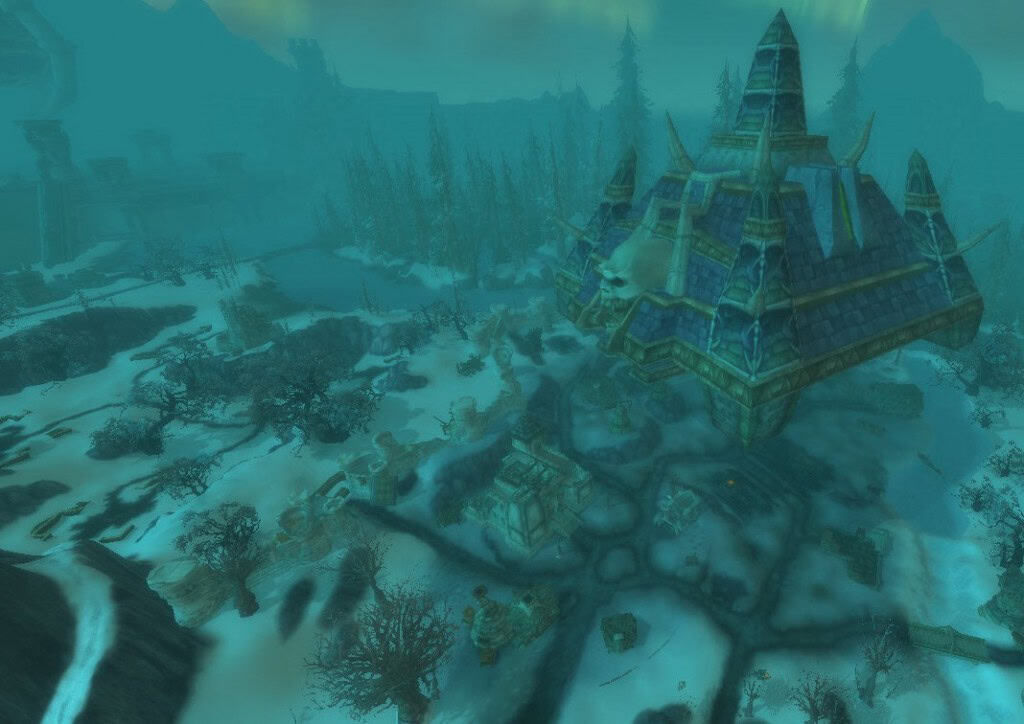
Dragonblight in 2008 was a zone of separate stories. For an Alliance player, the road ran through Wintergarde Keep, the 7th Legion fortress on the zone’s eastern edge, where the necropolis Naxxramas hung over the town. A dead courier on the road outside (The Lost Courier) pulled you into a hunt for a Scourge spy (Of Traitors and Treason) that ended at the desk of High Commander Halford Wyrmbane, and Wyrmbane had no shortage of problems to hand you.
The village below the keep had fallen (Naxxramas and the Fall of Wintergarde). Survivors were stranded in the smoke, and Flight of the Wintergarde Defender put you on a gryphon plucking them off rooftops. Townsfolk were cornered in the square (Rescue from Town Square). A dwarf had gone missing with his steam tank (Find Durkon!).


Then the orders turned downward. Into Hostile Territory sent you beneath the town, into the Wintergarde Mausoleum, and the zone’s real enemy showed his hand: Thel’zan the Duskbringer, the lich orchestrating the siege from inside Wintergarde’s own crypt. The quests that followed (Plunderbeard’s Journal, the two Chasing Icestorm quests, Finality) ran the threat to ground, and An End and a Beginning carried the news west, out of the keep’s story and into a larger one.


Because by then, the zone’s separate stories were coming together. To Fordragon Hold! delivered you to Highlord Bolvar Fordragon, massing Alliance troops within sight of the gate itself. Audience With The Dragon Queen brought you before Alexstrasza at Wyrmrest Temple. And the last leg (Galakrond and the Scourge, then On Ruby Wings) put you on the back of a red drake to stop the frost wyrm attacks bleeding Bolvar’s position, cutting down the cultist whose scythe was raising dead dragons against the Hold.
Meanwhile, on the other side of the map, Horde players were running a mirrored gauntlet through Agmar’s Hammer and Venomspite toward Kor’kron Vanguard. Two armies that did not trust each other were about to attack the same gate at the same time, and your quest log, which had been a list of chores, had become a mobilization order.

The design trick is worth naming, because no quest chain before it had pulled it off at this scale: the Wrathgate disguised its size. You did a zone’s worth of honest work, and the epic assembled itself around you. By the time Bolvar Fordragon walked his troops out of Fordragon Hold toward the Court of Skulls, you weren’t being told the stakes. You’d spent hours earning them.
Four Minutes That Changed Warcraft
You turn in a quest called Return to Angrathar, and the screen goes black.

What plays next is easy to undersell now, in an era when every expansion ships with hours of cutscenes. In 2008 it had no precedent. WoW’s cinematics were things that played before the game, at logins and launches.
The Wrathgate cinematic played inside it, mid-quest, the game’s first true in-game cinematic, as Blizzard itself now bills it: Bolvar Fordragon and Dranosh Saurfang leading a joint assault on the gate, the Lich King himself answering the challenge, and then the betrayal nobody saw coming. Forsaken catapults on the cliffs. The New Plague raining down on Scourge, Alliance, and Horde alike. Grand Apothecary Putress declaring that the Forsaken had neither forgotten nor forgiven anyone, the living included.
It took fourteen years for Blizzard to explain how they pulled it off, and the answer made the legend better. In a 2022 retrospective, lead cinematic narrative designer Terran Gregory revealed that WoW had no cinematic tools at all in 2008.
The camera that filmed the Wrathgate was a repurposed spectator add-on originally built for broadcasting arena tournaments, barely more sophisticated than a damage meter, and every in-game cinematic the game has made since descends from it. Most of the animations were ones that already existed in the game. The Horde’s charge up the steps of the gate, the shot everyone remembers, was a crowd of Blizzard employees logging in together and hitting the charge emote in sync. Other employees filled in as voices and stood in as extras where the custom characters couldn’t move the way the shot needed.
The most consequential four minutes in the game’s history were filmed, in essence, as the world’s most ambitious guild event. For a game whose whole legend is what players could do together, I can’t think of a more fitting production story.
Dranosh Saurfang died at the gate, and the sword that killed him would hand the story its cruelest sequel a year later. Bolvar fell in the plague fire, and the red dragons burned the field to cleanse it, which seemed at the time like a funeral. The Lich King, wounded by a weapon his own enemies had built, retreated behind his gate. And every player watching realized, in the space of a single cutscene, that the war they thought they were fighting had a third side.

One more detail, for the patient. After the cinematic, Alexstrasza and her consort Korialstrasz linger on the burned field, and they speak. Most of their exchange renders in Draconic, scrambled text to nearly everyone who stood there in 2008. The line itself was never meant to be read in-game, but its meaning leaked out anyway, passed around by the lore-obsessed: the Life-Binder telling her consort that the mortals must not learn the fate of the young paladin. Not yet. The young paladin was Bolvar Fordragon, and the line confirmed he was alive while the entire world believed the Blight had killed him, the single biggest spoiler of the expansion, sitting in plain Draconic on a quiet field a full year before the game would say it aloud. The translation lives on the quest page.
People stayed on that burned field longer than the quest required, because it was the only place to sit with what had just happened. Alexstrasza and her consort stood among the cinders like the last mourners at a funeral, which, for everyone who didn’t yet know Bolvar’s real fate, is exactly what it was.
I had no warning it was coming. I turned in the quest like any other, and the screen went black, and what played next left me sitting there not touching the keyboard. I was Alliance, and I still felt it when the younger Saurfang went down at the gate, the Horde’s hero dead in a cutscene I had no stake in, and somehow that made it hit harder. Trinity Exiles lit up over it, and the whole community was talking about the Wrathgate like something that had actually happened to all of us.
The Battle for the Undercity
The cinematic was the wound. The Battle for the Undercity was the rage.
On the Alliance side, the rage had a specific shape. Alexstrasza, standing in the ashes, handed you Bolvar’s charred shield and a quest called Reborn From The Ashes: carry it to Stormwind and lay it before the king. Varian Wrynn had been Bolvar’s friend. Bolvar held Stormwind together for years while its king was missing, standing as regent and looking after Varian’s young son in the meantime. Watching Varian receive that shield was watching a war start in one man’s face.
What happened next is, quietly, one of the best scenes in the expansion. Jaina Proudmoore talked Varian into letting her question Thrall before the fleets sailed, and Fate, Up Against Your Will put you through a portal into Orgrimmar as her escort. The city you found was emptied and locked down, its streets deserted except for Forsaken refugees huddled in the Valley of Strength, and the conversation between Jaina and Thrall played out in front of you: two leaders who liked each other, talking past the edge of a war neither could stop. She left through her portal praying their next meeting would be as allies. He turned and ordered transport to Undercity.
Both of them already knew.
Because the Horde’s leadership had discovered that the plague attack was half of a coup. The dreadlord Varimathras had seized Undercity itself, driving Sylvanas out of her own capital, and Putress had been his man all along. The Horde’s answer (Darkness Stirs, Herald of War, A Life Without Regret) sent Thrall and Sylvanas to take the city back.
The Alliance’s answer ran hotter. A Royal Coup brought the news to Stormwind, The Killing Time staged Varian’s forces at the sewer mouths, and then both factions hit the same city from two directions in a quest both versions shared: The Battle For The Undercity.
Two of those Alliance quest titles come from the same song. Fate, Up Against Your Will is a line lifted straight from The Killing Moon, Echo and the Bunnymen’s 1984 single about fate winning the argument with free will, and The Killing Time echoes another line from it. Somebody on the quest team scored the Alliance’s march to war with a post-punk elegy. The wikis record it in a footnote. It deserves better than a footnote.
The staging at the sewers held a second buried reference. The two figures Varian trusted with his vanguard, Broll Bearmantle and Valeera Sanguinar, were his companions from the years he spent as an amnesiac gladiator slave, a story told entirely in the World of Warcraft comic series that had been running since 2007 and had only just restored the missing king to his throne. Players who read the comic understood instantly why a night elf druid and a blood elf rogue were commanding Stormwind elites.
Players who didn’t simply met two strangers the king would apparently die for. The Battle for the Undercity was the comic’s payoff, made playable, and the game never stopped to explain it.

Mechanically, nothing like it had been attempted.
Two faction capitals, Undercity and Orgrimmar, were phased around the event: shops closed, streets emptied, NPCs displaced, an entire city-state of game infrastructure rearranged so that a level 74 quest could feel like history. You fought beside your faction leader, buffed into a temporary demigod: the Alliance buff was called Strength of Wrynn, the Horde’s was Warchief’s Blessing, each granting a massive health pool that turned an ordinary player into something closer to a raid boss, and on the Horde side Sylvanas sang a song that made resource bars effectively bottomless.
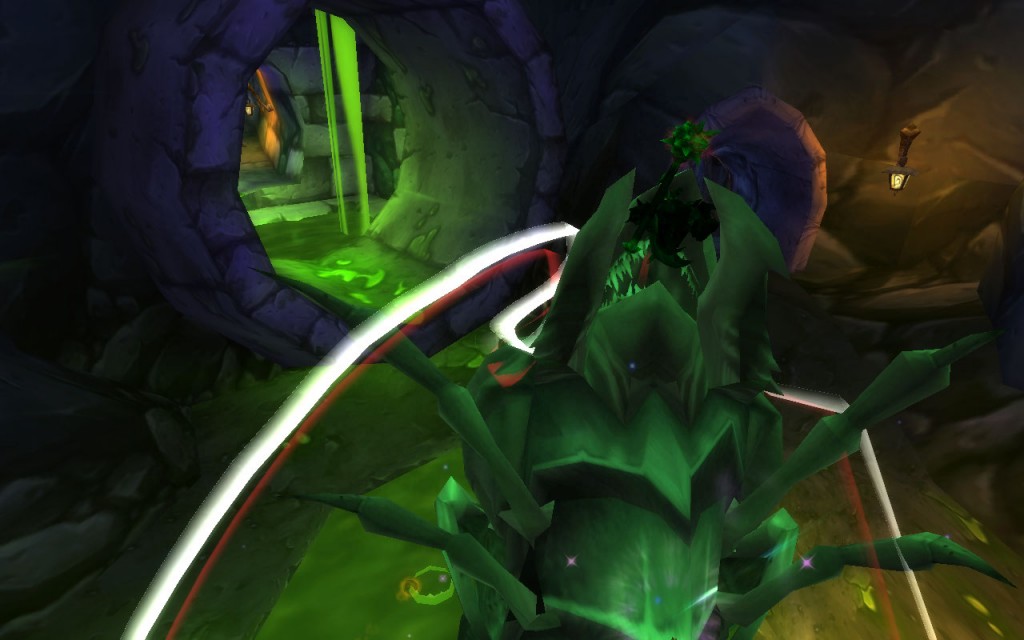
You did all this through streets you’d been banking and auctioning in for four years. The Alliance route ran through the sewers and into the Apothecarium, where Varian found the experiments Putress’s society had been running on human subjects, and where Putress himself died badly. The Horde route fought Varimathras down in the throne room, and slipped one perfect joke into the middle of its operatic finale: the moment Sylvanas senses his trap and calls the halt, the dreadlord snarls “clever girl,” the Jurassic Park line, at the exact wrong moment. It was unforgettable, and the engineering required to stage it is, as we’ll see, exactly what killed it.
The technology making all of this possible had humble origins. Phasing, the system that lets a single zone show different states to different players depending on what they’ve done, started life in Burning Crusade as a fix for one broken quest. Wrath was the expansion that saw what it could really do, and used it everywhere: a town you razed stayed razed for you while a friend mid-quest still saw it standing.
Most of Northrend used it quietly, to age a building or clear a battlefield. The Battle for the Undercity used it to rebuild two capital cities around one player’s quest log, the most aggressive thing anyone had asked the system to do. That was exactly why it couldn’t survive Cataclysm: when the 2010 revamp permanently rewrote those same cities, the temporary version the Wrathgate depended on had nowhere left to stand.
It ended in the throne room with the two factions pointed at each other over the corpse of their common enemy’s lieutenant. Varian’s speech in that room reached all the way back to the arenas he’d been forced to fight in as a slave, every grievance he’d carried home, and the war restarted in his voice before a sword was raised. Jaina stopped it the only way left: she froze every combatant in the room solid, mid-swing, and teleported the Alliance out. The truce was over. For the rest of the expansion, and for years of story afterward, the Wrathgate was the reason the Horde and Alliance could not be in a room together.
And the story kept paying out consequences long after the quest ended. Dranosh Saurfang’s body was carried into Icecrown Citadel and raised as the Deathbringer, so that the expansion’s final raid made his father fight what was left of him.

Bolvar’s fate turned out to be stranger than death, but that revelation belongs to the end of the expansion, and I’ll leave it there for anyone lucky enough not to know it yet.
Marginalia
Every museum keeps a drawer of small artifacts that don’t fit the main cases. A few from this one.
The gate is a portrait. Angrathar is built from saronite, the metal the tuskarr call the black blood of Yogg-Saron, and its silhouette is deliberately shaped to echo the Helm of Domination, the crown sitting on the head of the man behind it. The trading card game’s flavor text confirms the resemblance is intentional. You spend the entire chain assaulting a likeness of the Lich King’s own face, which means the cinematic’s most famous shot is Arthas stepping out from behind a mask of himself.
The plague doesn’t kill quietly. The cutscene puts screams under the green cloud, behind Bolvar, in the half-second before anyone understands what’s happening. It’s brief and most players were too stunned by the visuals to register the sound.
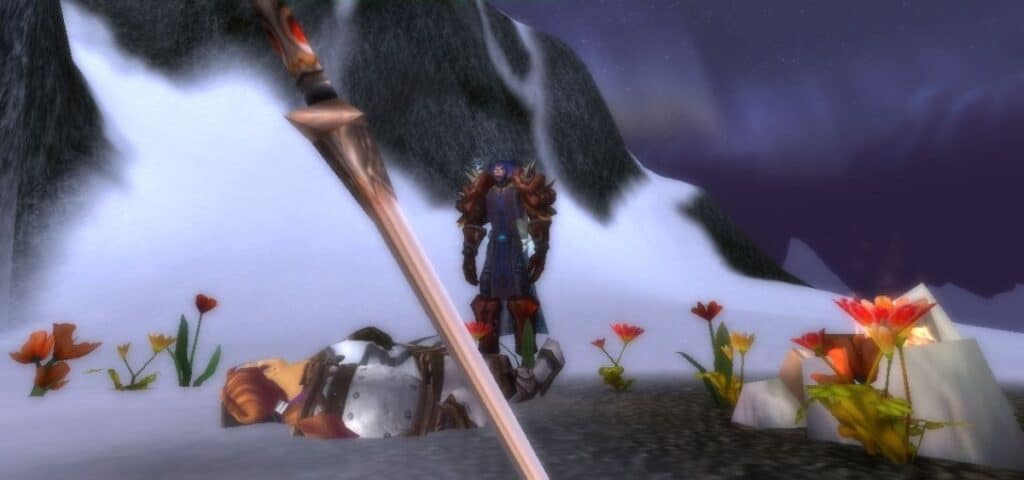
The cleansing worked, briefly. By the lore’s account, grass and flowers grew where the red dragons’ fire fell, life answering the Life-Binder’s flame on the worst ground in Northrend. The bloom didn’t last even in lore: a post-Shadowlands survey of the region records that the glacier has since reclaimed the slope. For a while, though, the site of the betrayal was the only green field in Dragonblight.
The reward was leggings. After a cinematic that rewrote the game’s story and a battle through two capitals, the quest paid out a blue item from the Wrynn’s series and went back in its drawer. The real reward was the achievement, Veteran of the Wrathgate, which did nothing, conferred nothing, and is still one of the proudest lines on any 2008 character’s armory page.
The Story That Changed. Twice.
Here’s the part I didn’t know until I researched this post, and I played the thing the year it shipped: the question of who ordered the Wrathgate has been given three official answers, spread across fourteen years, and the quests still tell the first one.
As written in 2008, the betrayal was a coup. Putress and elements of the Royal Apothecary Society had secretly pledged themselves to Varimathras, and the attack at the gate served the dreadlord’s takeover of Undercity. Sylvanas was a victim of it, driven from her capital, restored by the Horde’s counterattack. That’s the version the quests told, the version both factions avenged, and the version anyone who played it in 2008 or 2009 experienced as fact.
Ten years later, the answer changed in an interview. In November 2018, with Battle for Azeroth busy repositioning Sylvanas as a villain, creative director Alex Afrasiabi told Eurogamer that her arc wasn’t a departure at all, that he’d been writing the character since 2006, and that the Wrathgate and the Blight and the Forsaken’s whole apparatus “were all under Sylvanas’ orders.” The original story’s innocent victim was recast, in a single sentence, as its hidden author.
The community response was a firestorm, and an honest one, because the quests said otherwise on screen. Forum threads split between calling it the biggest retcon in Warcraft history and insisting Afrasiabi had simply misspoken. Wowhead ran a piece walking through every available interpretation. Nobody could settle it, because the only evidence on the new side was one sentence in one interview, and the only evidence on the old side was a quest chain that, by 2018, had already been deleted from the game for eight years. The thing that could have adjudicated the argument was, by then, unplayable.

The settling took four more years. Christie Golden’s 2022 novel Sylvanas, billed as the character’s definitive story, finally showed the scene, and the answer it gave was somewhere between the two. In the novel’s account, Sylvanas knew exactly what Putress was building, sponsored the Blight’s development, and instructed him to use it against the Lich King if the opportunity came. The targeting of the living, the speech from the cliffs, and the coup at Undercity were Putress and Varimathras acting for themselves, and her shock at the betrayal was real. So was her philosophy: by the novel’s reckoning, she’d have counted every death at Angrathar a fair trade if Arthas had died with them. The 2008 story and the 2018 claim turned out to each be holding half the answer, which is the most Sylvanas resolution imaginable.
I’m not here to litigate which version is best. That argument has been running on forums since 2018 and doesn’t need my help. What I’ll say is the museum’s version: all three are real artifacts. The novel is canon. The interview is history’s hinge. And the 2008 original is the thing millions of players actually experienced, avenged, and remember, and it survives in the quest text, the dialogue, and the screenshots on this site exactly as it was. When you read the Wrathgate quests in my Dragonblight lore guide, you’re reading the original, preserved before either rewrite. That’s not an accident. Preserving the as-played version of things is most of why this site exists.
Removed Twice
Status, June 2026. As of this writing, The Battle for the Undercity is playable on no official version of World of Warcraft, retail or Classic. The Classic Anniversary realms are mid–Burning Crusade, and whether they will ever reach Wrath is officially undecided. If that changes, it changes here first.
The Wrathgate has now died twice, and both deaths were announced the same way: quietly, in patch documentation, while players were looking at something else.
The first death came with Cataclysm. The 2010 world revamp rebuilt Azeroth, and the Battle for the Undercity’s elaborate staging, the phased capitals, the displaced NPCs, the throne room scripting, could not survive a world where Undercity’s storyline had moved on and Orgrimmar had been physically rebuilt. Blizzard confirmed it on the beta forums before launch: the Dragonblight chain would now end at the cinematic. The battle was amputated. For the next twelve years, on retail, you could march all the way to the gate, watch the betrayal, and then receive no way to answer it. The rage had nowhere to go.
WotLK Classic resurrected it in 2022, intact, exactly as shipped. For about twenty months, the complete arc was playable again, and a generation of players who’d only heard about it got to stand in the throne room themselves.
Then in May 2024, the progression servers advanced to Cataclysm Classic, and history repeated with eerie precision. The chain was removed a second time, for the same reasons, and the player confusion was word for word identical to 2010: forum threads from people who’d finished the cinematic and found Alexstrasza whispering them toward a quest that no longer existed.
Both removals followed the same logic, and both are reversible. Blizzard has restored this chain once already, intact, and could again whenever a Classic realm reaches Wrath. Whether that happens, and when, is the one open question this post can’t answer for you, so it lives in the box above, dated, where it can be kept honest. Everything below the box is settled.
Why the Screenshots Exist
I didn’t know any of this was coming in 2008. I wasn’t documenting the Wrathgate because I foresaw two removals and two rewrites. I documented it because I documented everything that year, every storyline quest in Northrend, on a first playthrough that could never be repeated. It just turned out that some of what I photographed would become unrepeatable for everyone.
The complete Wrathgate chain lives on this site the way it shipped: every quest, every step, every screenshot from the original run, inside Vikstone’s Classic Expedition. If you played it, it’s there the way you remember it. If you never got the chance, it’s the closest thing to standing at the gate that currently exists.

If the chain comes back, this is the companion to it, the story and the original screenshots the game’s own UI never showed you. If it never comes back, this is simply what’s left.
The page works either way, which is the only kind of promise worth making about Blizzard’s plans.